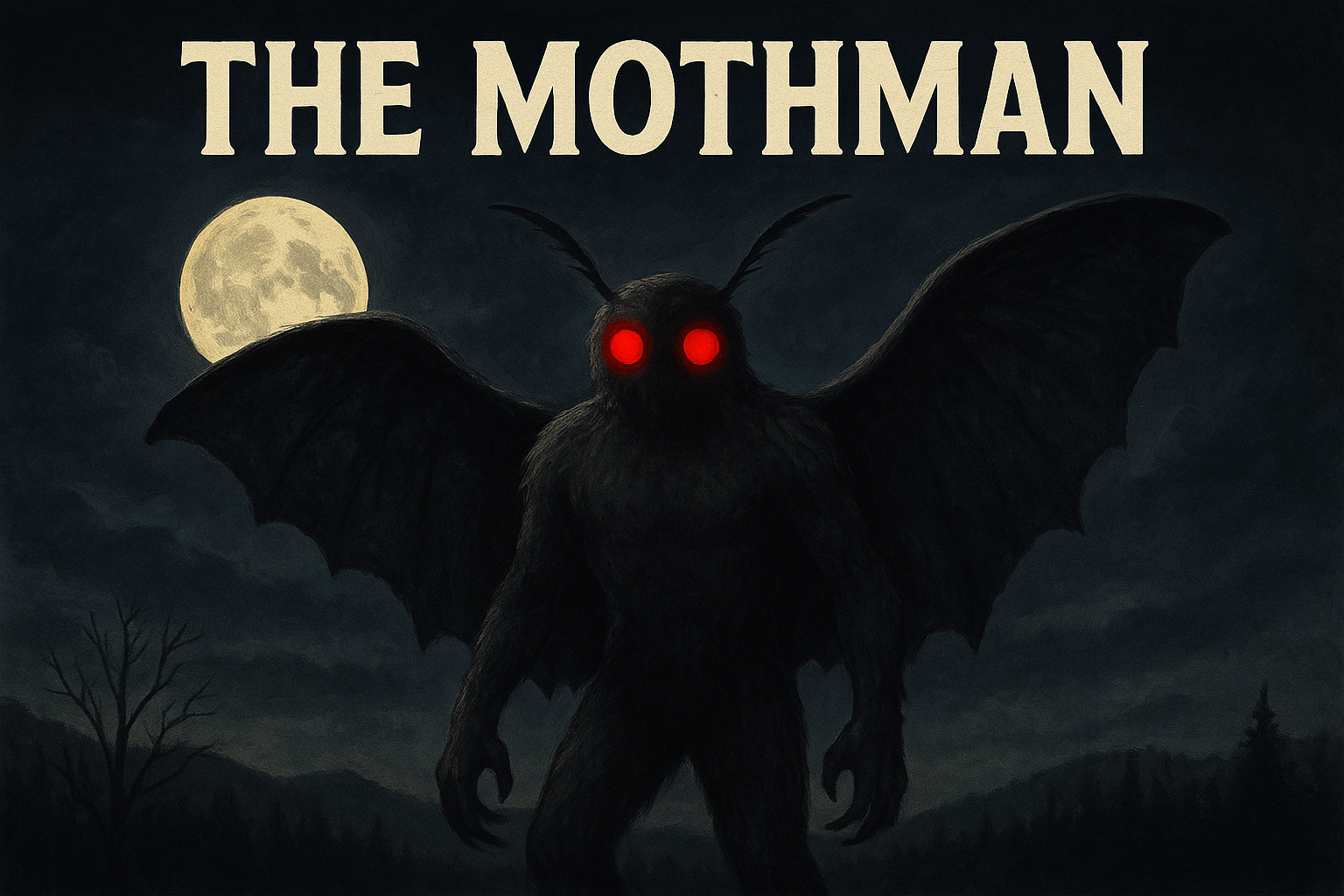
The Mothman: Legend, Sightings & Theories Behind West Virginia’s Most Mysterious Creature
Few American cryptids have captured public imagination like The Mothman—a red-eyed, winged humanoid said to haunt the skies of Point Pleasant, West Virginia. Since the 1960s, witnesses have described a terrifying creature that seems part bird, part man, and entirely unexplainable. Is it a misidentified animal, a paranormal omen, or something stranger altogether? Here’s a full look at the history, sightings, and theories behind the enigmatic Mothman.
Origins of the Legend
The Mothman legend began on November 12, 1966, when five gravediggers reported seeing a man-shaped figure with large, dark wings gliding overhead near Clendenin, West Virginia. Although unsettling, their encounter gained little attention—until three days later.
On November 15, 1966, two young couples—Roger & Linda Scarberry and Steve & Mary Mallette—claimed they encountered a gray humanoid creature standing six to seven feet tall with glowing red eyes near the old TNT Area outside Point Pleasant. According to their account, the creature unfurled its wings and pursued their car at speeds over 100 mph.
This second sighting launched one of the most famous cryptid cases in American folklore.
Point Pleasant’s Wave of Sightings (1966–1967)
Between late 1966 and 1967, over 100 reports of a similarly described creature flooded into local law enforcement and newspapers. Witnesses described:
- Enormous wings spanning 8–10 feet
- Red, hypnotic eyes
- A human-like torso but no clearly defined arms
- High-pitched screeching sounds
- Aerodynamic movement without flapping wings
The epicenter of activity was the TNT Area, an abandoned WWII munitions site with concrete domes and dense forest—an environment ideal for rumors of lurking creatures.
The Silver Bridge Collapse Connection
The sightings abruptly ended after a major tragedy.
On December 15, 1967, the Silver Bridge connecting Point Pleasant to Ohio collapsed, killing 46 people. Some locals believed the Mothman sightings were warnings of an impending disaster, a belief later popularized by John Keel’s 1975 book The Mothman Prophecies and its 2002 film adaptation.
Whether coincidence or supernatural omen, this association became a permanent part of the legend.
Possible Explanations for the Mothman
While the creature remains unidentified, several theories have emerged over the decades:
1. Misidentified Birds
The most commonly proposed natural explanation is the sandhill crane, a large migrating bird with:
- A wingspan up to 7 feet
- Reddish skin around the eyes
- Unusual calls
However, locals insisted what they saw was far too large and humanoid to be any known bird.
Another possibility is the barred owl, which has reflective red eyeshine at night—but it is far too small for most reported descriptions.
2. Mass Hysteria
Skeptics argue that the initial reports, amplified by newspaper coverage, created a feedback loop of fear and expectation, causing people to interpret normal stimuli as the creature.
3. A Cryptid or Unknown Species
Cryptozoologists have suggested:
- A previously unknown species of large flying animal
- A mutated creature from the TNT Area’s toxic environment
- A relic pterosaur-like being
None of these theories have physical evidence but remain popular in folklore communities.
4. Paranormal or Interdimensional Being
In John Keel’s view, the Mothman was not merely a creature but part of a pattern of paranormal phenomena, including:
- UFO sightings
- Men in Black encounters
- Psychic visions
Some interpret the Mothman as an omen, a watcher, or an entity appearing during times of crisis.
Modern Sightings and Cultural Impact
The Mothman legend didn’t end in the 1960s. Modern reports continue to surface, including:
- 2016–2017 sightings in Chicago
- Occasional eyewitness accounts throughout Appalachia
- Numerous online videos and alleged photos, though none verified
Point Pleasant has embraced its most famous resident with:
- The Mothman Museum
- The Mothman Festival (drawing thousands each year)
- A 12-foot metallic Mothman statue, now a major tourist attraction
The creature is now a fixture in American pop culture, appearing in documentaries, films, books, video games, and paranormal TV programs.
Why the Mothman Endures
The Mothman remains iconic because it sits at the border of mystery:
- Too many witnesses to dismiss
- Too little evidence to prove
- A creature appearing before disaster
- A story blending fear, folklore, and tragedy
It represents the unknown—something lurking just beyond the edge of explanation.