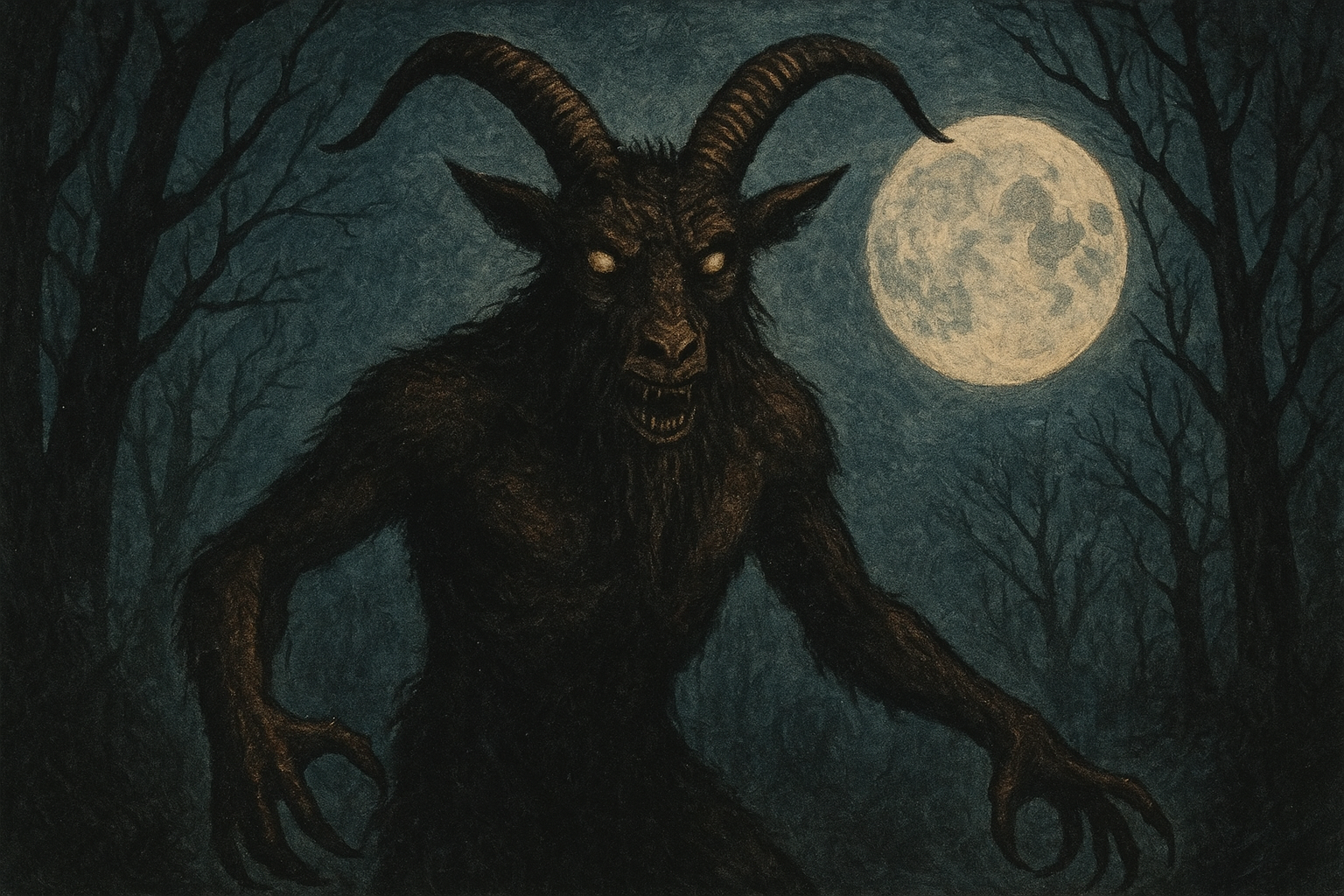
For decades, travelers, campers, and local residents across the United States have whispered about a creature stalking the edges of rural highways and wooded corridors—a being half-man, half-goat, driven by rage, vengeance, or something older and more primal. The stories surface in Maryland, Kentucky, Texas, and points between, all tied together by a shared archetype: the Goat Man, a horned humanoid said to wield terrifying strength, eerie intelligence, and a taste for stalking those who wander too close to the forest’s edge.
Some call it a cryptid. Others swear it is supernatural. A few insist it is a twisted remnant of science gone wrong. But no matter the interpretation, the Goat Man stands as one of America’s most unnerving modern legends—because it is not tied to a single region, a single origin, or a single generation. It moves, evolves, and reappears, refusing to fade.
This is the deep dive into the phenomenon.
I. The Legend’s Many Birthplaces
While most cryptids are regional, the Goat Man seems to be everywhere. Strikingly similar descriptions appear in separate states, decades apart, with no apparent connection between witnesses. This geographic spread is part of what makes the legend so resilient.
1. Maryland’s Infamous Goatman
The most widely recognized version resides in Prince George’s County, Maryland. Reports date back to the 1950s, but the story truly took hold in the 1970s when locals began reporting a 7-foot, horned humanoid near Bowie.
Core elements of the Maryland legend:
- A creature lurking near Fletchertown Road.
- Sighting reports near the Governor Bridge area.
- Car scratches attributed to an axe-wielding humanoid goat-like figure.
- Claims of mutilated pets and livestock.
One persistent telling describes a government agricultural experiment gone wrong—a goat-human hybrid created at the Beltsville Agricultural Research Center. While purely fictional, the rumor refused to die, becoming part of the urban legend’s canon.
2. Kentucky’s Pope Lick Monster
Kentucky’s Goat Man haunts the Pope Lick Trestle, an active train bridge in the Louisville area. This version is more sinister, combining cryptid lore with psychological horror.
Witnesses describe:
- A human-like figure with goat legs.
- Pale or mottled skin.
- Small horns protruding from the forehead.
- Eyes capable of hypnotic influence.
In this narrative, the creature lures victims onto the trestle, placing them in the path of oncoming trains. Over the decades, numerous accidental deaths have occurred at the site—real tragedies that cement the Goat Man’s mythos.
3. Texas’s Lake Worth Monster
The Lake Worth Monster terrorized Fort Worth, Texas, in the summer of 1969. Dozens of reports emerged of a large, white, goat-like humanoid throwing tires at cars and chasing teens from the lakeside cliffs.
Though skeptics dismissed the sightings as hoaxes, several witnesses—including police officers—filed reports describing the same creature. This consistency has kept the case alive in Texas folklore.
II. What Is the Goat Man Supposed to Be?
Theories about the Goat Man’s nature fall into four broad categories. Each reveals something about cultural fears—and the difficulty in placing this creature neatly into any single box.
1. A Cryptid Yet Uncatalogued
Many believe the Goat Man is a North American cryptid, akin to Bigfoot or Mothman. Supporting points include:
- Multiple independent sightings across different states.
- Similar anatomy described: cloven hooves, furred legs, humanoid torso, horns.
- Its tendency to avoid direct contact yet remain visible long enough for credible reports.
However, no consistent footprint or physical evidence has been authenticated.
2. A Supernatural or Demonic Entity
The Goat Man’s appearance evokes ancient mythologies—Pan, satyrs, fauns, and demonological figures associated with forests, chaos, and temptation.
Features aligning with supernatural lore include:
- Hypnotic influence (Pope Lick accounts).
- Apparitions that vanish instantly.
- Reports of sulfur-like smells.
- Appearing and disappearing around bridges and thresholds (symbolically powerful liminal spaces).
3. A Human-Engineered Hybrid
In Maryland’s account, the “government experiment” theory emerged during the 1970s craze of mistrust in science and laboratories. While biologically impossible, the rumor persisted because it fit the era’s anxieties.
4. A Modern Urban Legend Fueling Itself
Some folklorists argue that the Goat Man is a narrative echo—different regions independently producing similar stories because the imagery resonates with human psychology: the fear of being hunted in wilderness, the corruption of the human form, and the idea of predators watching from just beyond the treeline.
III. Modern Sightings: The Creature Persists
The Goat Man is not just a relic of mid-20th century storytelling. Reports continue, especially among:
- Hunters
- Night hikers
- Roadside travelers
- Urban explorers
A 2015 Maryland Report
A pair of hikers near Bowie described a tall, horned silhouette observing them from behind a cluster of trees. When they approached, the figure moved with unnatural speed, clearing nearly 20 feet before vanishing.
Kentucky Encounters in the 2010s
Trespassers near the Pope Lick Trestle have reported:
- A “half-man figure crouched on the beam”
- Something with glowing eyes pacing them from the forest
- Disembodied bleating sounds with human cadence
Texas Sightings Resurfacing
Local residents claimed in 2020 that a white-furred creature was seen again near Lake Worth. Though unverified, the descriptions were remarkably consistent with the 1969 reports.
IV. Behavioral Traits: What Witnesses Agree On
Despite the wide distribution, core behaviors repeat across states:
1. Territorial aggression.
The Goat Man is often described as defending bridges, rural roads, abandoned structures, or wooded trails.
2. Rock-throwing and object manipulation.
Texas accounts famously describe tire-throwing; Kentucky has reports of stone impacts during encounters.
3. Nocturnal appearances.
Witnesses overwhelmingly report activity between dusk and early morning.
4. Vocalizations.
Sounds associated with the creature include:
- Bleating mixed with human-like tones.
- Deep growls.
- Bellowing, echoing cries described as both animal and human.
5. Predatory stalking.
Many encounters describe the creature watching from cover, pacing travelers, or following vehicles.
V. Why the Goat Man Endures
The Goat Man has become an enduring piece of American folklore for several key reasons:
1. The Power of Multiplicity
Unlike single-location legends, the Goat Man is many things in many places. This flexibility keeps the story alive, evolving with each generation.
2. The Archetype of the Hybrid Monster
The mix of human and animal suggests broken boundaries—something both familiar and deeply wrong.
3. Real-World Tragedies That Feed the Legend
The deaths at Pope Lick Trestle and other incidents create a gravity around the myth, anchoring fiction to sobering reality.
4. The Fear of the Forest
We project ancient fears into wooded spaces—darkness, isolation, the unknown. The Goat Man manifests these fears with a physical presence.
VI. Final Assessment: What Are We Dealing With?
Whether cryptid, spirit, fabrication, or something stranger, the Goat Man refuses to disappear. Its sightings span decades, its descriptions remain consistent, and its legend has woven itself into America’s paranormal landscape.
The Goat Man stands at the crossroads of folklore and fear—half human, half beast, endlessly watching from the treeline. And until claims stop and the forests fall silent, the legend lives on.
Below is a companion article designed to pair with your main Goat Man feature. This piece focuses on a sightings timeline, state-by-state variations, and how each regional version differs in behavior and lore. It is long-form, structured, and optimized for blog publication.
Tracking the Goat Man: A Timeline of Sightings and State-by-State Variations
For a creature that supposedly hides in the shadows of America’s forests, the Goat Man leaves a remarkably consistent trail behind him—snapshots of encounters occurring across decades and across state lines. Unlike many cryptids anchored to one region, the Goat Man manifests as a distributed phenomenon: appearing in Maryland one decade, terrorizing Texas another, and resurfacing near Kentucky train trestles with chilling regularity.
This phenomenon raises a compelling question: Are these fragmented stories simply echoes of the same archetype, or is something truly stalking America’s backroads?
This companion article catalogs the most notable sightings and regional variations to help readers track how the legend evolved over time.
I. Sightings Timeline: Key Incidents From 1950s to Today
1950s – Maryland’s First Whispers
The earliest verifiable references to a “goatman” in the United States originate in Prince George’s County, Maryland. Locals reported a horned figure seen near backroads and wooded patches along Fletchertown Road. These stories circulated mostly by word of mouth at the time.
1962 – Mysterious Livestock Mutilations (Maryland)
Farmers in the Bowie area reported goats and small livestock found mutilated. While authorities blamed predators, locals insisted something bipedal was responsible.
1969 – Lake Worth Monster Terrorizes Texas
Fort Worth experienced a streak of bizarre encounters where witnesses—including law enforcement—reported a large white creature, part-human and part-goat.
Key events include:
- A creature throwing a tire at a vehicle.
- Multiple sightings near Greer Island.
- Dozens of teenagers fleeing the lake cliffs after being chased.
Newspaper coverage made the Lake Worth Monster the first Goat Man to achieve national attention.
1971 – The Maryland Goatman Urban Legend Explodes
A widely circulated local newspaper article described the Goatman slaughtering a dog and threatening teens near Governor Bridge Road. This article solidified the creature’s mythology in Maryland folklore.
1970s–1980s – Kentucky’s Pope Lick Monster Gains Momentum
Reports emerged around the Pope Lick Trestle near Louisville, describing:
- A horned humanoid.
- A pale goat-like creature with hypnotic abilities.
- A manipulative entity luring victims onto the tracks.
While some sightings were likely trespass-related encounters with trains or wildlife, the legend intensified due to accidents at the site.
1990s – Sightings Spread Across Appalachia
Reports of Goat Man-like creatures began appearing in:
- West Virginia
- Tennessee
- North Georgia
Most described shadowy, goat-legged figures pacing vehicles or stalking hunting camps.
2010 – Resurgence in Kentucky
Urban explorers and local thrill-seekers posted online accounts of growls, screams, and a “horned figure” crouching on the Pope Lick trestle at night.
2012 – Maryland Hikers Encounter a Tall Horned Silhouette
A pair of hikers near Bowie claimed a 7-foot figure observed them silently from behind trees before sprinting away in long, unnatural strides.
2020 – Lake Worth Sightings Reignite
Local residents claimed the creature reappeared near Fort Worth’s lake region. Descriptions mirrored 1969 reports: white fur, goat-like legs, and startling speed.
2021–2024 – Midwest and Southern Reports
Scattered sightings continue from:
- Missouri
- Oklahoma
- Alabama
- North Carolina
Descriptions vary but retain the core Goat Man traits: horns, cloven or oddly shaped feet, and a hunched, muscular upper body.
II. State-by-State Variations: How Each Region Shapes the Monster
Not all Goat Men are created equal. While the core anatomy stays consistent, each region has adapted the creature to its geography, fears, and local folklore.
1. Maryland – The Government Experiment Gone Wrong
Signature Traits:
- Origin tied to the Beltsville Agricultural Research Center.
- Often described wielding an axe or using tools.
- Aggression toward vehicles and hikers.
- Seen near bridges, narrow roads, and wooded residential margins.
Behavioral Profile:
This version is less supernatural and more feral, often portrayed as a physical creature with brute strength. It is the most “urban legend” oriented of all variants, shaped directly by newspaper stories and teenage lore.
2. Kentucky – The Pope Lick Monster
Signature Traits:
- Goat-human hybrid with pale skin or patchy fur.
- Known for hypnotic or mimicking abilities.
- Associated with a railroad trestle and acts as a lure.
Behavioral Profile:
This variant leans heavily into psychological horror. It is often described as intelligent, manipulative, and capable of influencing human behavior. Its environment—a towering, dangerous train bridge—adds symbolic weight and real danger.
3. Texas – The Lake Worth Monster
Signature Traits:
- White or gray fur.
- Emphasis on physical strength.
- Known for throwing objects (tires, rocks).
- Loud, bellowing vocalizations.
Behavioral Profile:
This version resembles a cryptid more than a demon or hybrid. Witnesses describe it as powerful but animalistic. Texas sightings are among the most publicly documented due to televised and newspaper coverage.
4. Appalachia (West Virginia, Tennessee, Virginia) – The Hillside Stalker
Signature Traits:
- Shadowy goat-like silhouette.
- Long limbs and glowing eyes.
- Rarely seen clearly.
Behavioral Profile:
This variant is more spectral than physical. Witnesses typically report it watching from ridgelines, pacing hikers, or emerging briefly from tree lines before vanishing. It fits Appalachian traditions of mountain spirits and watchers.
5. Deep South (Alabama, Mississippi, Georgia) – The Backwoods Shepherd
Signature Traits:
- Hoofed humanoid, often described with a staff or horn-like apparatus.
- Appears near abandoned churches or rural graveyards.
- Emits unsettling vocalizations.
Behavioral Profile:
Southern versions evoke folklore tied to crossroads entities, rural spirits, and protective—or punishing—guardians. These encounters blend cryptid structure with ghost-story ambiance.
6. Midwest (Missouri, Oklahoma, Kansas) – The Roadside Pursuer
Signature Traits:
- Seen crossing roads at night.
- Often chases or paces vehicles.
- Described with pronounced horns and digitigrade legs.
Behavioral Profile:
This Goat Man type behaves like a predator guarding territory. Sightings occur most frequently along farm roads, river curves, or rural highways.
III. How Regional Variations Reveal the Legend’s Evolution
1. The Goat Man morphs to fit local fears.
Industrial anxiety fuels the Maryland hybrid myth; trestle tragedies fuel Kentucky’s hypnotic monster; Texas’s creature mirrors rural beasts and frontier threats.
2. Environments shape the creature’s behaviors.
A railroad bridge creates a lure-based monster; lakeshore cliffs create a creature capable of throwing objects; suburban woods create a silent watcher.
3. Common threads reflect a shared archetype.
Across every region, witnesses describe:
- Horned humanoids
- Hoof-like feet
- Nocturnal activity
- Aggressive territorial behavior
This suggests the Goat Man legend taps into a universal human fear: the corrupted reflection of ourselves lurking in nature.
IV. Is It One Phenomenon or Many? A Comparative Assessment
Some theories propose:
A. A Single Migratory Cryptid
The sightings might reflect the movements of a solitary, highly elusive species, similar to how Bigfoot encounters map across the continent.
B. Parallel Legends Emerging Independently
Different communities created similar figures because the goat-human hybrid is deeply rooted in mythological archetypes.
C. One Legend That Spread and Mutated
Maryland’s Goatman may have seeded the meme, with other states adapting the framework to local settings.
D. A Supernatural Entity Shifting Geography
A more paranormal explanation suggests the Goat Man appears near regions of fear, tragedy, or liminality—bridges, cliffs, abandoned structures—regardless of state.
V. Final Analysis: Mapping a Monster That Refuses to Be Contained
The Goat Man is not one creature—it is a phenomenon. Part cryptid, part legend, part psychological imprint. Its enduring presence across states reveals a creature too powerful to confine to a single origin story, too resilient to vanish with time, and too deeply embedded in American folklore to dismiss.
Whether the sightings represent a physical being, a supernatural entity, or a cultural archetype, the Goat Man continues to walk alongside America’s dark woods, bridges, and forgotten places—hoofprints echoing from one state to the next.