Few paranormal cases have generated as much controversy, investigation, and enduring fascination as The Enfield Poltergeist. Occurring in a modest council house in North London between 1977 and 1979, the case became one of the most intensively studied and publicly debated hauntings in modern history. Unlike many ghost stories that rely solely on oral tradition, Enfield produced audio recordings, photographs, written logs, eyewitness testimony from police officers, journalists, and researchers, and years of firsthand investigation by members of the Society for Psychical Research (SPR).
To believers, Enfield represents compelling evidence of genuine poltergeist activity. To skeptics, it is an elaborate case of deception, hysteria, and misinterpretation. The truth, as with most enduring paranormal mysteries, may lie somewhere in between.
The Hodgson Family and the House on Green Street
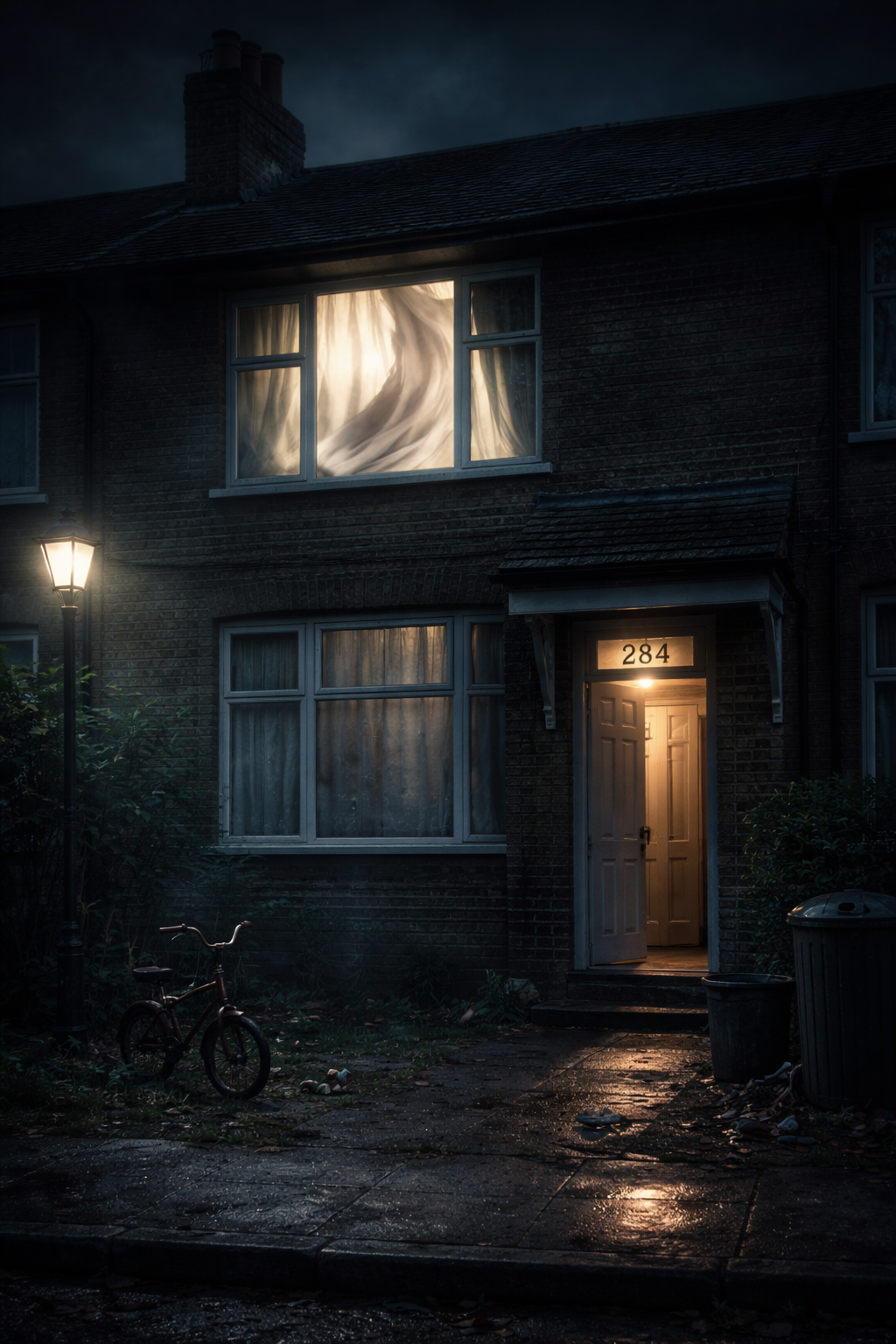
The events centered on 284 Green Street, Enfield, a small terraced home occupied by Peggy Hodgson, a single mother, and her four children: Margaret (13), Janet (11), Johnny (10), and Billy (7).
By August 1977, the family had been living in the house for over a year without incident. That changed abruptly when the children began reporting strange nighttime disturbances—knocking sounds, furniture moving, and objects shifting without explanation.
At first, Peggy Hodgson suspected neighborhood pranks or childhood mischief. However, the disturbances escalated rapidly in both intensity and frequency.
The First Major Incident
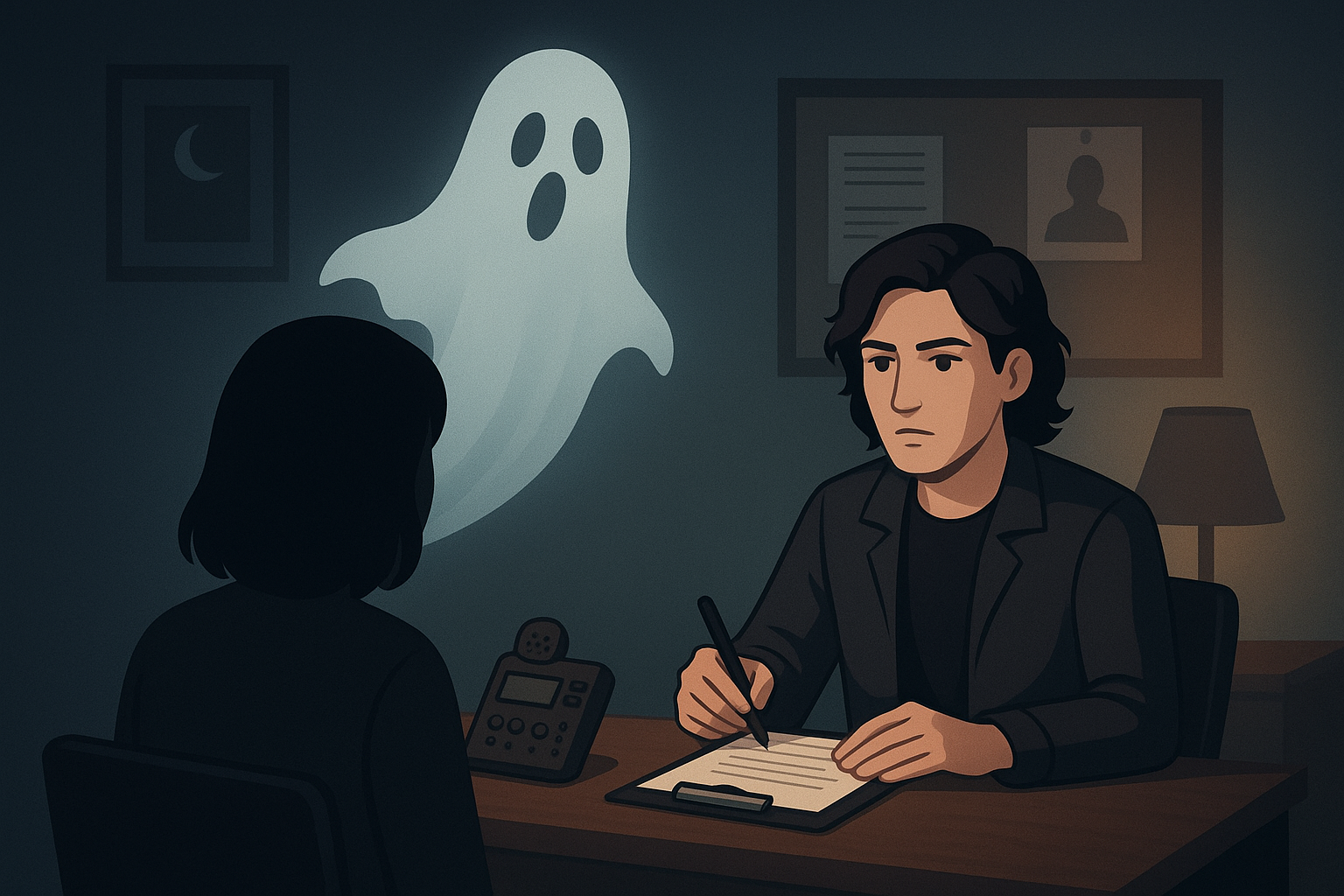
On the night of August 30, 1977, Peggy Hodgson contacted the police after witnessing a chest of drawers slide several feet across the floor on its own. Two police officers responded to the call. One officer later provided a written statement confirming that she observed a chair move independently, without anyone touching it.
This police corroboration was crucial. Law enforcement officers had no incentive to embellish the incident, and their testimony helped transform the situation from a family dispute into a potential paranormal case.
Within days, local newspapers picked up the story, and the house became the focus of growing public attention.
Escalation of Activity
Over the following weeks, the reported phenomena intensified dramatically:
- Furniture overturned or shifted violently
- Toys, bricks, and household items thrown across rooms
- Loud knocking and banging on walls and ceilings
- Drawers opening and closing by themselves
- Beds shaking violently during the night
The disturbances appeared to center primarily around Janet Hodgson, the second-oldest child. Many incidents occurred when she was present or nearby, a pattern consistent with classic poltergeist cases, which often involve adolescents.
The Investigators Arrive
In September 1977, members of the Society for Psychical Research (SPR) became formally involved. Among them were Maurice Grosse, a seasoned paranormal investigator, and later Guy Lyon Playfair, a writer and researcher with a background in psychical studies.
Unlike casual ghost hunters, Grosse and Playfair maintained detailed logs, audio recordings, photographs, and nightly observation schedules. Their involvement lasted more than a year, making Enfield one of the longest continuously investigated hauntings on record.
The “Voice from the Chair”
One of the most unsettling aspects of the Enfield case was the emergence of a raspy, disembodied voice that appeared to speak through Janet while she was in a trance-like state.
The voice identified itself as “Bill Wilkins,” claiming to be the spirit of a former occupant of the house who had died in a chair in the living room. According to historical records later uncovered, a man by that name had indeed lived nearby and died years earlier—though whether this was coincidence remains contested.
The voice was recorded on tape dozens of times. It spoke in a hoarse, strained manner, often claiming exhaustion and pain. Medical professionals later noted that sustaining such a voice for long periods would likely cause throat damage, yet Janet reportedly showed no lasting injury.
Physical Evidence and Photographs
The Enfield case produced some of the most famous images in paranormal history, including photographs showing Janet apparently levitating or being thrown from her bed.
These images became iconic—and controversial.
Critics argue that the photos depict jumping rather than levitation, captured at the peak of motion. Investigators countered that even if some images were exaggerated or staged, they did not account for the vast number of independently witnessed events, many occurring without warning or opportunity for trickery.
Audio recordings captured knocking sounds that appeared to respond intelligently to questions, using a system of one knock for “yes” and two for “no.”
Allegations of Fraud
No serious discussion of the Enfield Poltergeist is complete without addressing the allegations of deception.
At various points during the investigation, Janet and Margaret were caught bending spoons or attempting to recreate phenomena when they believed they were unobserved. These incidents were widely publicized and remain a central argument for skeptics.
However, both Grosse and Playfair openly acknowledged these moments in their reports. They argued that isolated acts of trickery do not invalidate the entire case, especially given the volume of activity witnessed directly by investigators, journalists, neighbors, and police officers.
Importantly, some of the most dramatic events occurred when the children were restrained, asleep, or not present at all.
Psychological and Environmental Explanations
Skeptics have proposed several alternative explanations:
- Child psychology and attention-seeking behavior
- Subconscious stress manifestations, particularly in a single-parent household under financial strain
- Environmental factors, such as vibrations from passing trains or plumbing issues
- Mass suggestion and confirmation bias
While these explanations may account for certain elements, none have fully explained the intelligent responsiveness, physical force behind object movement, or corroborated eyewitness testimony from trained observers.
Decline and End of the Phenomena
By late 1978, the activity gradually diminished. The voice became less frequent, objects stopped flying, and the house returned to relative normalcy.
The Hodgson family continued to live in the home for several years afterward, reporting only occasional minor disturbances. No similar activity was ever reported at the property again on the same scale.
Janet Hodgson, now an adult, has maintained that while she regrets participating in moments of trickery, the majority of the events were genuine and terrifying. She has described the experience as deeply traumatic rather than entertaining.
Legacy and Cultural Impact
The Enfield Poltergeist has left an indelible mark on paranormal research and popular culture:
- It inspired books, documentaries, and academic debate
- It served as the basis for The Conjuring 2 (2016)
- It remains a cornerstone case in discussions of poltergeist phenomena
Unlike many hauntings rooted in centuries-old folklore, Enfield unfolded in the modern era, under media scrutiny and sustained investigation.
An Unresolved Mystery
More than four decades later, the Enfield Poltergeist remains unresolved. It is neither a case that can be fully dismissed nor one that can be conclusively proven.
For believers, it represents one of the strongest modern examples of genuine paranormal activity. For skeptics, it is a cautionary tale about human psychology, media influence, and the unreliability of eyewitness testimony.
Perhaps its enduring power lies precisely in that ambiguity. The Enfield Poltergeist sits at the uneasy intersection of belief and doubt, forcing both sides to confront uncomfortable questions about what we truly understand—and what we may never fully explain.
CASE FILE: THE ENFIELD POLTERGEIST
Case Classification: Poltergeist / Recurrent Spontaneous Psychokinesis (RSPK)
Location: 284 Green Street, Enfield, North London, England
Dates Active: August 1977 – Late 1978 (sporadic into 1979)
Primary Witnesses: Peggy Hodgson; Janet Hodgson (11); Margaret Hodgson (13); Johnny Hodgson (10); Billy Hodgson (7)
Investigating Bodies: Society for Psychical Research (SPR)
Lead Investigators: Maurice Grosse; Guy Lyon Playfair
Secondary Witnesses: Metropolitan Police officers; journalists; neighbors; medical professionals
CASE OVERVIEW
The Enfield Poltergeist is widely regarded as one of the most extensively documented paranormal cases in modern British history. Unlike many hauntings supported only by anecdotal testimony, this case generated police statements, investigator logs, audio recordings, photographs, and contemporaneous media coverage. While allegations of fraud emerged during the investigation, researchers maintained that these incidents did not account for the totality or complexity of the phenomena observed.
The activity primarily centered on Janet Hodgson, a pre-adolescent child—consistent with established poltergeist case patterns—though multiple incidents occurred independently of her presence.
PROPERTY BACKGROUND
The Hodgson family had occupied the residence for over a year without reported incidents. No prior hauntings were associated with the property. The home was a standard council house in a densely populated residential area, eliminating isolation as a contributing factor.
PHENOMENA CATALOG
Documented activity included:
- Furniture moving without physical contact
- Objects (toys, bricks, household items) thrown across rooms
- Loud knocking and banging sounds responding intelligently to questions
- Drawers opening and closing autonomously
- Beds shaking violently
- Apparent levitation or forceful displacement of a child
- Disembodied vocalizations speaking through Janet Hodgson
CHRONOLOGICAL TIMELINE
August 30, 1977 — Initial Police Incident
Peggy Hodgson reports a chest of drawers sliding across the floor unaided. Metropolitan Police officers attend the scene.
Police Witness Statement (Excerpt):
“I witnessed a chair move across the living room floor without anyone touching it.”
This corroboration marks the first official acknowledgment of unexplained physical movement.
Early September 1977 — Escalation
Reports increase in frequency and intensity. Furniture overturns; objects are thrown with sufficient force to cause concern for injury. Neighbors report hearing loud, unexplained knocking sounds.
September 5–7, 1977 — Media Attention
Local newspapers publish initial reports. Journalists witness unexplained knocking phenomena and object movement, increasing public scrutiny.
September 1977 — SPR Investigation Begins
Maurice Grosse begins nightly observation. Detailed logs, tape recordings, and photographic documentation commence.
Investigator Log (Grosse):
“Activity often begins suddenly and without apparent cause. Objects move with force inconsistent with child trickery.”
October 1977 — Vocal Phenomena Emerges
A harsh, low-frequency voice manifests, apparently speaking through Janet while she is in a dissociative state.
The voice identifies itself as ‘Bill Wilkins,’ claiming to have died in a chair in the living room.
Audio Recording Transcript (Excerpt):
“I’m tired… I died in the chair… I don’t like it here.”
November–December 1977 — Peak Activity
This period marks the highest frequency of phenomena.
- Multiple witnesses observe furniture lifting or sliding
- Objects strike walls and ceilings
- Knocking responds intelligently to questions
Journalist Witness Statement:
“The knocks answered questions accurately, even when the children were restrained.”
Early 1978 — Photographic Evidence
Photographs capture Janet apparently lifted or thrown from her bed.
Contested Evidence Note:
Critics argue these images depict jumping. Investigators maintain that photographs alone do not represent the entirety of observed phenomena.
Mid-1978 — Allegations of Fraud
Investigators observe Janet and Margaret attempting to bend spoons and simulate activity.
SPR Response:
These incidents are formally logged and acknowledged. Investigators state that deception occurred intermittently but does not explain sustained phenomena witnessed independently.
Playfair Commentary (Excerpt):
“You do not get hundreds of incidents witnessed by adults and officials from two children play-acting.”
Late 1978 — Decline of Activity
Phenomena gradually decrease in intensity and frequency. Vocal manifestations cease entirely.
1979 — Case Conclusion
SPR involvement winds down. No comparable recurrence reported after investigators withdraw.
PSYCHOLOGICAL AND ENVIRONMENTAL ANALYSIS
Proposed explanations include:
- Adolescent stress-related psychokinesis
- Dissociative states
- Attention-seeking behavior
- Environmental vibration or structural factors
None fully account for corroborated physical force, intelligent responses, or third-party testimony.
CURRENT STATUS
The property no longer reports paranormal activity. Janet Hodgson, now an adult, maintains that while some trickery occurred, the majority of events were genuine and frightening.
CASE ASSESSMENT
Strengths:
- Multiple independent adult witnesses
- Police corroboration
- Extensive contemporaneous documentation
Weaknesses:
- Proven instances of fraud
- Media influence and observer bias
Final Determination:
Unresolved — The Enfield Poltergeist remains one of the most complex and debated cases in psychical research history.
Prepared for archival and research purposes.