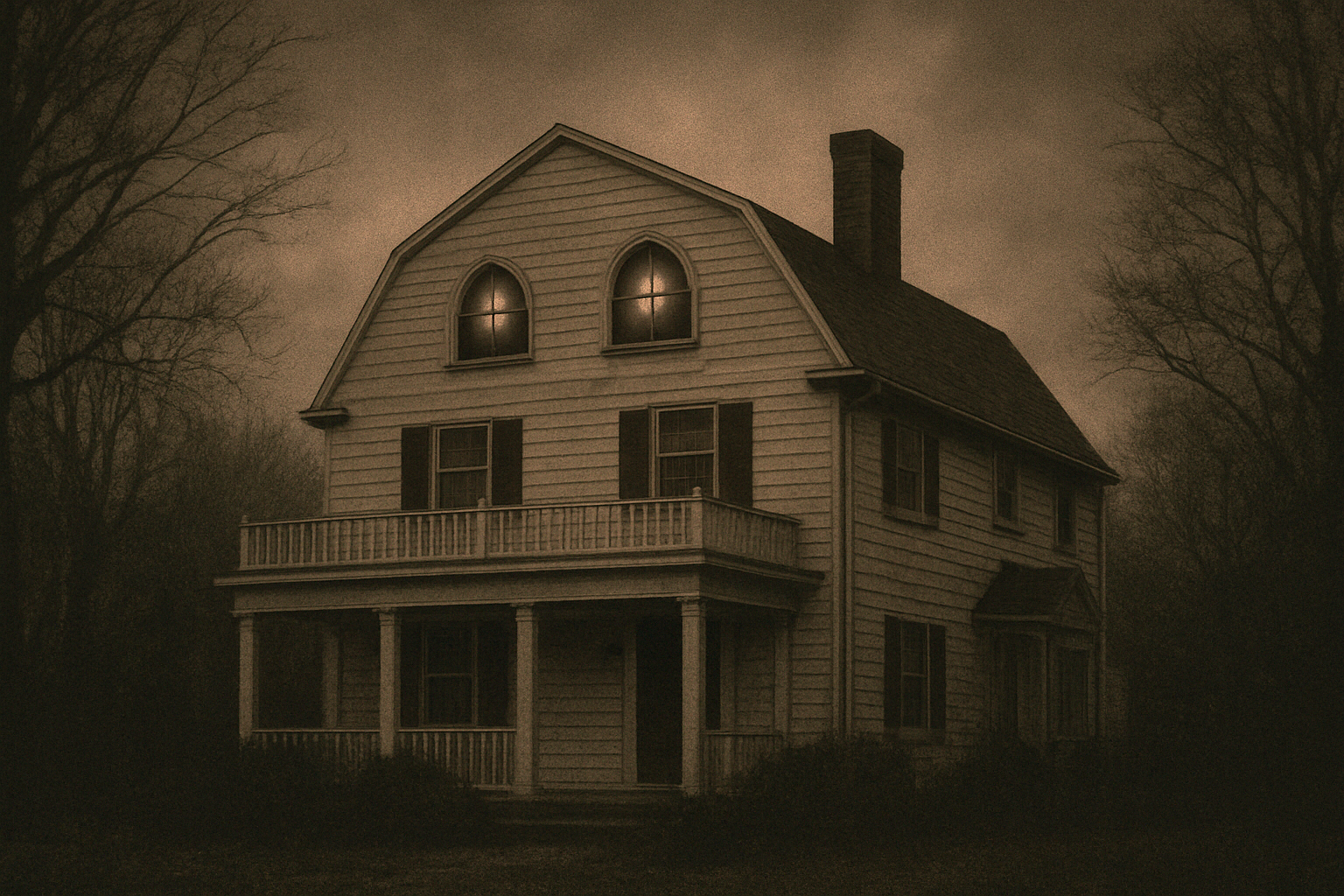
In the quiet Long Island village of Amityville, New York, a Dutch Colonial house overlooking a canal became the center of one of the most polarizing paranormal controversies in American history. Known globally as The Amityville Horror, the story exists at the intersection of verified mass murder, disputed supernatural claims, and a media machine eager for fear.
Unlike many haunted house legends, Amityville begins with something indisputably real: six people were murdered in their sleep. Everything that followed—voices, apparitions, demonic forces—remains fiercely debated.
November 13, 1974: A Family Annihilated
Shortly after 6:00 a.m., Ronald “Butch” DeFeo Jr. walked into a local bar claiming his parents had been shot. Police soon discovered the bodies of Ronald DeFeo Sr., Louise DeFeo, and four children—all lying face down in their beds.
The crime scene presented troubling anomalies:
- No signs of struggle
- No evidence of drugging
- Neighbors reported hearing no gunshots
- All victims remained in bed despite the noise of a high-powered rifle
DeFeo confessed but gave multiple conflicting accounts, often claiming that voices in the house compelled him to kill. Psychiatrists diagnosed him with antisocial personality disorder, not psychosis. He was convicted and sentenced to six life terms.
The house at 112 Ocean Avenue became synonymous with familial annihilation.
A House with a Reputation
For over a year, the DeFeo home sat largely unoccupied. Locals whispered. Potential buyers backed out. Realtors struggled to show the property without addressing its history.
In December 1975, George and Kathy Lutz, newly married, purchased the house for a price far below market value. They acknowledged awareness of the murders but insisted they were unfazed.
Within weeks, they claimed, the house began to change.
The Lutz Account: 28 Days of Escalation
According to the Lutzes, disturbances were not immediate but incremental, growing more invasive over time.
Their reported experiences included:
- George Lutz developing sudden mood changes and obsessive behaviors
- Kathy experiencing violent nightmares focused on death and confinement
- Persistent cold spots localized to certain rooms
- Doors and windows opening despite being locked
- A black, tar-like substance oozing from walls
- The family dog refusing to enter certain rooms
- A large pig-like entity reportedly observed by one child
The most frequently cited detail was 3:15 a.m., the approximate time of the DeFeo murders. George reportedly woke at that hour nightly, drawn to the same location where the rifle had been stored.
The family abandoned the house abruptly, leaving personal belongings behind.
Clergy, Investigators, and the Language of Possession
A Catholic priest—later identified under a pseudonym—was invited to bless the home. He reported hearing a voice commanding him to leave and experiencing physical illness afterward. The diocese later declined to comment publicly, citing confidentiality.
Paranormal investigators soon followed. Among them were Ed and Lorraine Warren, who concluded that the house was not haunted by ghosts but oppressed by a demonic presence attached to the land.
Their findings emphasized:
- Residual energy from violence
- A non-human intelligence
- Psychological targeting of occupants
Photographs from investigations allegedly captured unexplained figures, including a now-famous image showing glowing eyes in a doorway—an image still disputed by skeptics and believers alike.
Publishing the Horror
In 1977, author Jay Anson released The Amityville Horror, marketed as a true story based on the Lutz family’s testimony. The book was an immediate commercial success.
Its impact was enormous:
- The public largely accepted the account as factual
- The house became a pilgrimage site
- Hollywood secured adaptation rights within months
The narrative hardened quickly. Amityville became shorthand for evil inhabiting domestic space.
Contradictions and Collapse
As scrutiny increased, cracks appeared.
Subsequent owners reported no paranormal activity. Weather records contradicted claims of freezing temperatures. Witness statements shifted over time.
Most damaging were legal proceedings in which the Lutzes acknowledged that some events were dramatized, though they insisted the core experience was genuine.
Later, Ronald DeFeo Jr. claimed the haunting was fabricated during conversations with the Lutzes and their attorney—statements many dismiss due to his history of manipulation.
Still, no definitive evidence emerged to prove total fabrication.
The House Without the Myth
The property was later renovated and renumbered. The iconic attic windows—often described as resembling eyes—were removed. Owners discouraged attention. Trespassing laws were enforced.
Today, the house looks ordinary. The canal is quiet. Children play nearby.
Yet the name persists.
What Remains Unanswered
The Amityville case endures because it resists resolution. It presents:
- A confirmed mass murder
- Psychological trauma amplified by environment
- Financial incentives to embellish
- Investigators with conflicting conclusions
There is no final report. No definitive debunking. No proof of demons.
Only layers.
The Legacy of Amityville
Whether viewed as a cautionary tale, a hoax, or a genuine brush with something inhuman, the Amityville Horror reshaped American paranormal culture. It blurred the line between true crime and supernatural narrative, influencing decades of horror media and investigation.
Perhaps the most unsettling possibility is not that the house was haunted—but that the human mind, under pressure, can transform a place of violence into something far worse.
Because in Amityville, the horror did not begin with ghosts.
It began with family.