Introduction
They do not arrive with flashing lights or official paperwork.
They arrive quietly.
A knock at the door. A phone call that should not be possible. A stranger already waiting inside a room you know was empty moments before. These are the first signs that you have attracted the attention of the Men in Black.
Those who claim to have encountered them agree on one thing: once they appear, life never returns to normal. The Men in Black are not merely suppressors of information—they are enforcers of silence, and their methods are subtle, intimate, and deeply disturbing.
The First Whispers of the Black-Suited Visitors
The modern legend of the Men in Black emerged alongside the earliest UFO reports of the late 1940s and early 1950s. As sightings increased, so did reports of witnesses being visited shortly afterward by strange men who seemed intensely interested in what had been seen.
One of the earliest and most chilling cases involved Albert K. Bender, a prominent UFO researcher who abruptly ended his investigations in 1953. He later claimed three men visited him, radiating hostility without ever raising their voices. After that night, Bender refused to speak about UFOs again.
Others would follow.
Researchers who pushed too far vanished from the public eye. Witnesses recanted detailed testimonies without explanation. Entire investigations ended overnight.
Their Appearance: Human, But Not Quite
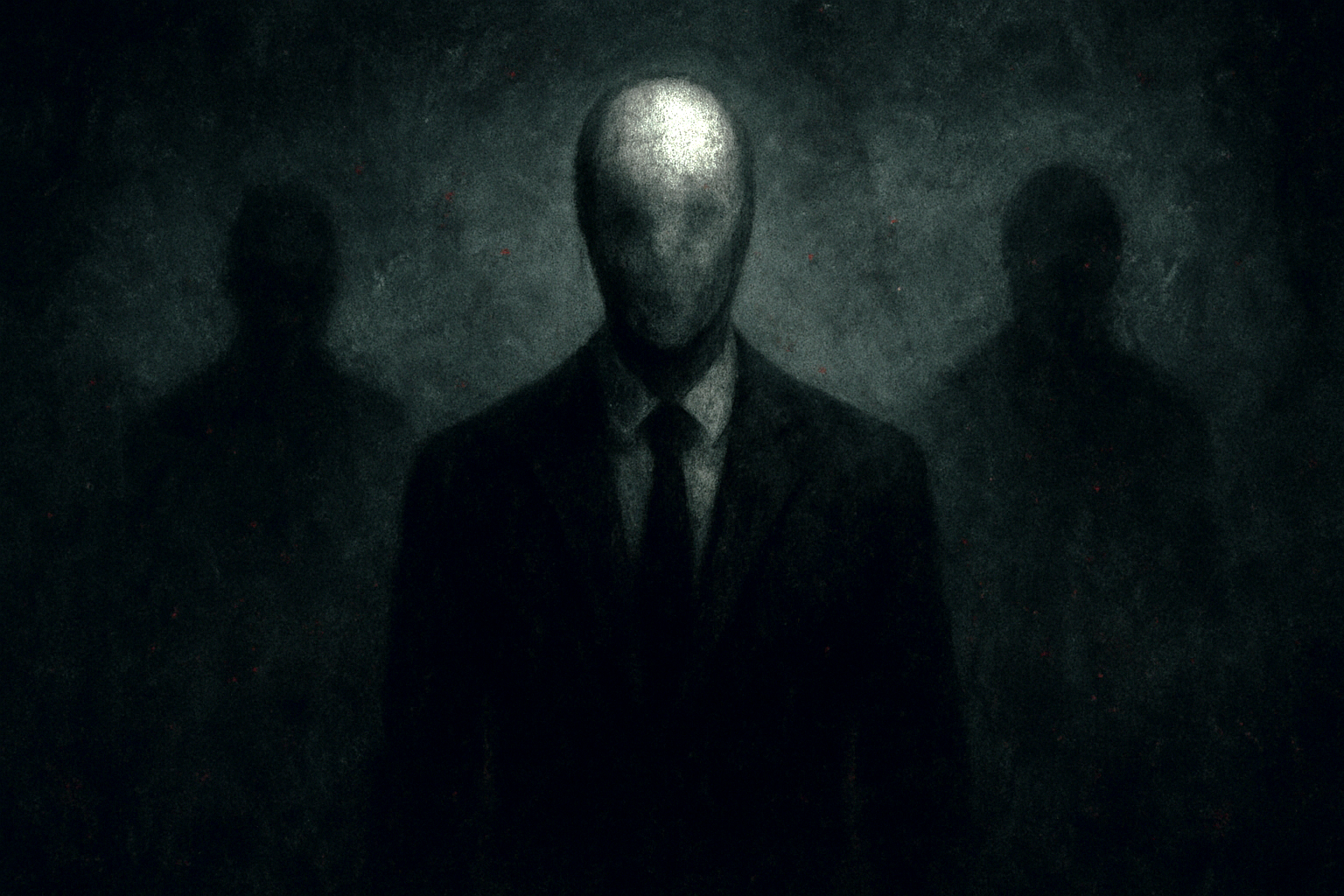
Descriptions of the Men in Black are eerily consistent, as if witnesses are recalling the same figures rather than similar ones:
- Perfectly black suits, often outdated
- Stark white shirts and thin black ties
- Dark sunglasses worn regardless of lighting
- Skin described as waxy, pale, or “unfinished”
But the fear does not come from how they look.
It comes from how they move.
Witnesses describe rigid posture, delayed reactions, and expressions that never change. Some report the men speaking in flat, rehearsed sentences, as though language itself is unfamiliar to them.
Several encounters include disturbing details:
- Inability to understand common objects
- Difficulty eating or drinking
- Incorrect use of everyday words
- A lingering smell of ozone, sulfur, or burning metal
The overwhelming impression is this: whatever they are, they are pretending to be human.
The Visit
A Men in Black encounter follows a pattern.
They already know your name.
They already know what you saw.
They may reference conversations you never told anyone about. Some witnesses claim the men accurately described thoughts they had never spoken aloud.
The message is always the same:
Stop talking.
Sometimes the warning is polite. Other times it is delivered with a thin smile and a promise that “accidents” happen to people who do not cooperate.
In many cases, the Men in Black predict future events—job loss, illness, family trouble. When these predictions later come true, witnesses are left wondering whether they were threats… or inevitabilities.
Are They Government Agents?
Official explanations claim the Men in Black are nothing more than government investigators or intelligence operatives. Yet this theory collapses under scrutiny.
True government agents:
- Carry verifiable identification
- Follow clear procedures
- Do not behave erratically
The Men in Black do none of these things.
They provide no agency names. Their credentials are often incorrect or nonsensical. Some witnesses report phone numbers that lead nowhere—or to disconnected lines that never existed.
Even more unsettling, some encounters occurred before any government interest could reasonably exist.
Something Inhuman Behind the Eyes
A growing number of researchers believe the Men in Black are not human at all.
Extraterrestrial Imitators
One theory suggests the Men in Black are non-human entities attempting to mimic human authority, imperfectly copying appearance and behavior.
Interdimensional Enforcers
Others believe they originate from outside our reality, appearing only when certain knowledge threatens to cross an unseen boundary.
Manifestations of Control
A darker idea proposes the Men in Black are not physical beings at all, but manifestations—appearing only to those who glimpse something they were never meant to see.
Whatever the explanation, their presence feels deliberate, targeted, and deeply personal.
The Aftermath: Life Under Watch
Those who receive a visit rarely speak about it again.
Witnesses describe:
- Persistent paranoia
- Sudden financial or personal hardship
- Nightmares involving faceless men
- A constant feeling of being observed
Some report seeing black cars parked outside their homes for days. Others experience unexplained phone calls filled only with static—or breathing.
The message lingers long after the men are gone:
You were warned.
Why the Men in Black Endure
Unlike monsters that attack from the shadows, the Men in Black operate in plain sight. They do not need violence. Their power lies in certainty—certainty that they know what you saw, certainty that they can reach you, certainty that silence is the safer option.
They represent a terrifying possibility:
That some truths are actively policed.
And that the universe has its own way of making sure we stop asking questions.
Conclusion: If They Haven’t Come Yet
If you are reading this and have seen something you cannot explain, you may already be wondering whether it was a mistake to tell anyone at all.
Most people never receive a visit.
But those who do all say the same thing:
The Men in Black do not knock twice.
Men in Black: Documented Encounters vs. Dark Theories
Introduction
Stories of the Men in Black exist in a space where reported experience and speculation overlap. This article separates what witnesses have claimed to experience from the theories that attempt to explain those claims.
The accounts below are presented as reported testimonies drawn from UFO literature and witness statements. The explanations that follow are theoretical interpretations, not established fact.
PART I — REPORTED ACCOUNTS (WHAT WITNESSES SAY HAPPENED)
Consistent Elements Across Accounts
Across decades of reports, witnesses independently describe similar details following UFO sightings:
- Visits occurring shortly after a sighting or report
- Men dressed uniformly in black suits
- Unannounced arrivals at homes, workplaces, or hotel rooms
- An insistence that the witness stop discussing what they saw
These elements appear in cases separated by time, geography, and social background.
The Albert K. Bender Case (1953)
Albert K. Bender, founder of the International Flying Saucer Bureau, publicly claimed that three men visited him after his UFO research gained attention. According to Bender:
- The men offered no clear identification
- They spoke calmly but conveyed hostility
- He was warned to cease his investigations
Shortly afterward, Bender dissolved his organization and withdrew from public UFO research entirely. This case is frequently cited as one of the first modern Men in Black reports.
Researcher Intimidation Reports
UFO authors and investigators throughout the 1950s–1970s reported similar experiences:
- Being followed by black vehicles
- Receiving threatening phone calls
- Sudden visits from men claiming vague authority
In several cases, researchers abandoned their work soon after these encounters, citing fear for personal safety.
Witness Descriptions of the Visitors
Witnesses commonly report unsettling behavioral traits:
- Flat or emotionless speech
- Awkward or delayed responses
- Incorrect use of everyday words
- Difficulty interacting with ordinary objects
Some accounts also include sensory details such as unusual odors (ozone or sulfur) or an oppressive atmosphere during the encounter.
These descriptions are claims, not verified observations.
PART II — THEORIES (ATTEMPTS TO EXPLAIN THE ACCOUNTS)
Theory 1: Secret Government Operatives
Claim: The Men in Black are part of a covert government program designed to suppress sensitive information.
Problems with the theory:
- Reported behavior often lacks professional consistency
- No verified agency or documentation has ever been produced
- Government agencies deny the existence of such operations
While plausible on the surface, this explanation fails to account for many reported irregularities.
Theory 2: Extraterrestrial Mimicry
Claim: The Men in Black are non-human entities attempting to imitate human authority figures.
Supporters of this theory point to:
- Mechanical speech patterns
- Physical awkwardness
- Inconsistent understanding of human behavior
There is no physical evidence supporting this interpretation.
Theory 3: Interdimensional Enforcers
Claim: The Men in Black originate from outside conventional reality and appear only when certain knowledge is accessed.
This idea stems from:
- Their sudden appearances and disappearances
- Knowledge of private thoughts or conversations
- Their apparent role as boundary-keepers
This theory remains entirely speculative.
Theory 4: Psychological or Symbolic Manifestations
Claim: Men in Black encounters are psychological responses to trauma, fear, or belief systems triggered by UFO sightings.
This explanation suggests:
- Stress-induced hallucinations
- Memory reconstruction
- Cultural folklore influencing perception
Critics argue this fails to explain shared details across unrelated witnesses.
PART III — WHERE FACT ENDS AND FEAR BEGINS
No physical evidence conclusively proves the existence of the Men in Black.
No single theory fully explains the reports.
What remains are patterns—and the discomfort they produce.
The Men in Black persist not because they are proven, but because the accounts surrounding them refuse to disappear.
Conclusion
This phenomenon lives at the intersection of testimony and theory. Whether misunderstood officials, imagined enforcers, or something stranger, the Men in Black occupy a unique place in modern folklore.
What is undeniable is this:
People continue to report the same story.
And once they tell it, many never speak again.
© 2025 Unexplained Files. All rights reserved.
This article presents reported accounts and speculative theories for informational purposes only. It does not assert the factual existence of the Men in Black.