Living Giant Thunderbirds: Are Enormous Winged Creatures Still Flying Our Skies?
For centuries, stories of enormous winged creatures—known as Thunderbirds—have echoed across North America and beyond. These legendary beings appear in Indigenous oral traditions, frontier accounts, and modern eyewitness reports. While many consider them purely mythological, a surprising number of contemporary sightings continue to suggest that something massive may still be flying overhead.
Today, the Thunderbird remains one of the most enduring mysteries in cryptozoology: a creature that seems too big to exist—yet too widely reported to dismiss.
Ancient Legends of the Thunderbird
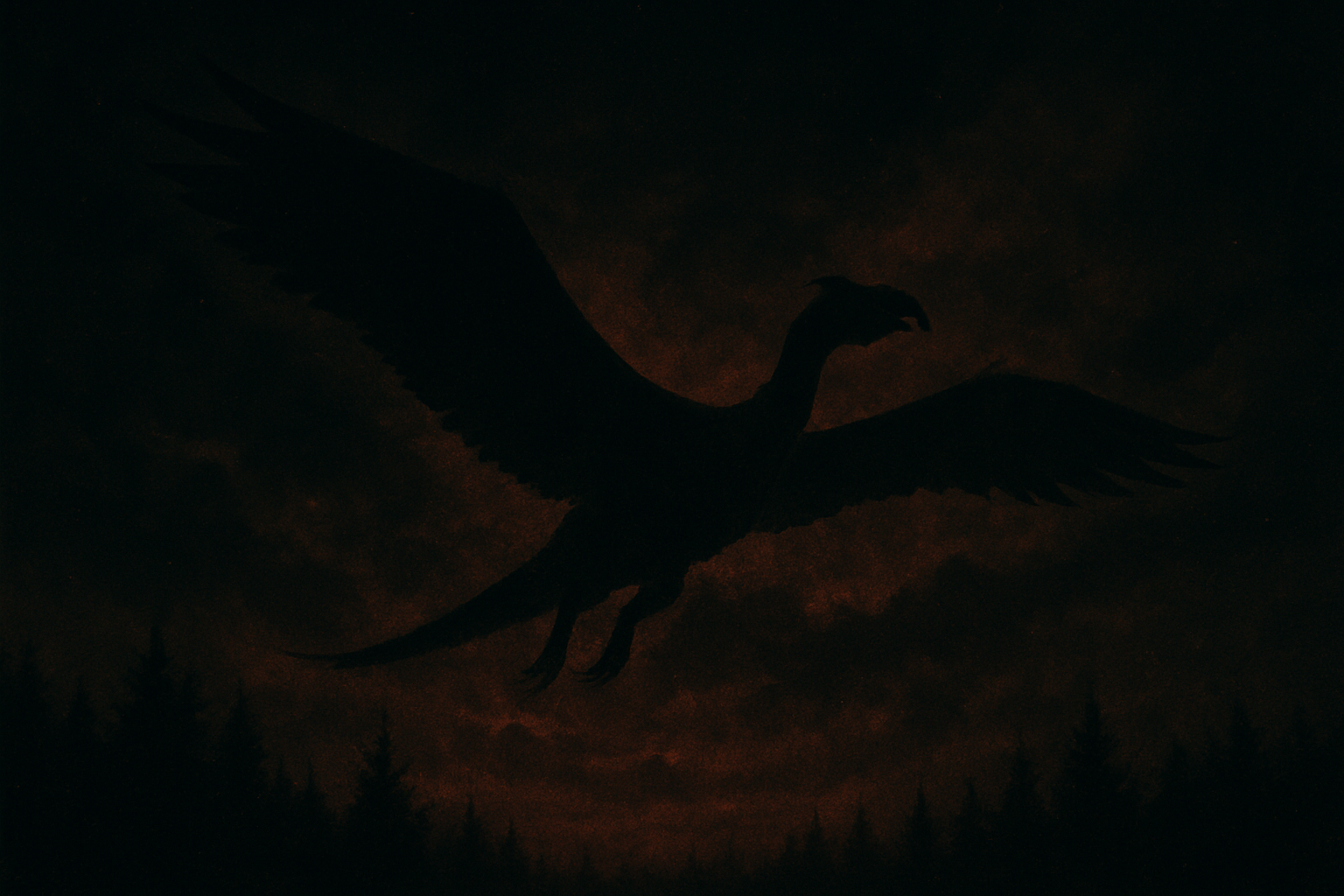
In Native American lore, the Thunderbird is a powerful sky spirit, capable of creating storms with the beat of its wings and controlling thunder and lightning. Tribes from the Pacific Northwest to the Great Plains describe the creature consistently:
- Enormous wings that darken the sky
- Feathers the size of canoe paddles
- Eyes that glow like embers
- A wingspan stretching 15 to 30 feet or more
These stories were not simply myths—they were treated as genuine accounts of real beings that shaped the world.
Historical Sightings: The Thunderbird in Early America
Long before modern roads or cameras, early settlers and explorers recorded encounters with astonishingly large birds. Some of the most famous include:
The 1890 Tombstone Encounter
Arizona cowboys reportedly shot and killed a creature with a wingspan of over 20 feet, described as reptilian—more like a surviving pterosaur than a bird. The mysterious photograph said to show the carcass has never been verified, but the story refuses to die.
The Alaskan Giant Birds
Bush pilots throughout Alaska have reported massive black birds soaring above remote valleys—so large they were initially mistaken for small airplanes.
The Pennsylvania Sightings of the 1960s
Multiple witnesses described a gigantic, bat-like creature flying over rural areas, with wings so large they blocked out stars.
Accounts like these laid the foundation for the Thunderbird’s modern legend.
Modern Reports: Are Thunderbirds Still Alive Today?
In the past several decades, the number of sightings has increased—especially in rural, mountainous, and coastal regions. Witnesses consistently describe creatures that do not match any known bird species.
Common Features Reported
- Wingspans between 12 and 30 feet
- Dark or black feathers
- Slow, powerful wingbeats
- A beak shaped like a vulture or condor, but far larger
- The ability to ascend without struggling, even in calm air
- Silence in flight—no detectable sound despite enormous wings
Some reports describe a bird-like creature, while others mention a reptilian, leathery-winged form, more like a pterosaur.
This has led researchers to debate whether “Thunderbird” may refer to multiple species, or perhaps a surviving prehistoric lineage.
Could a Giant Bird Really Exist?
Surprisingly, nature offers several clues supporting the possibility.
1. Prehistoric Giants Once Dominated the Sky
Species like Argentavis magnificens, with a wingspan near 23 feet, actually existed. This proves that enormous flying creatures are biologically possible.
2. Remote Wilderness Provides Cover
Vast areas of North America—Alaska, the Pacific Northwest, the Yukon, and the Rockies—remain largely undocumented by humans.
3. Many Large Birds Are Masters of Staying Hidden
Condors, eagles, and other huge birds often go unseen despite modern surveillance and technology.
The idea that a giant raptor could survive in remote ecosystems is not impossible—just unlikely enough to spark lifelong mystery.
Explanations: What Are Witnesses Seeing?
Researchers propose several possibilities:
1. Oversized Eagles or Condors
Misjudged distance can dramatically exaggerate size—especially against the sky.
2. Surviving Prehistoric Species
Some cryptozoologists believe a small population of giant birds or pterosaur-like creatures may have persisted in remote regions.
3. Unknown Species of Megafauna
A yet-undiscovered, enormous raptor could inhabit high mountains or deep wilderness.
4. Folklore Interpreted as Physical Creatures
Some argue Thunderbirds may be symbolic beings rather than literal animals—yet this fails to explain modern sightings.
The Enduring Mystery
Thunderbird reports continue to surface, often from hunters, hikers, truck drivers, and pilots—people accustomed to recognizing wildlife. Many describe encounters too vivid and too consistent to ignore.
Whether the Thunderbird is:
- a surviving giant bird,
- a misidentified known species,
- a relic from prehistory, or
- something even stranger…
the phenomenon remains one of the most intriguing mysteries in the skies.
Until physical evidence is found, the Thunderbird will continue to soar between legend and reality—a shadow on the horizon, a shape against the clouds, and a reminder that not all the world’s secrets have been uncovered.