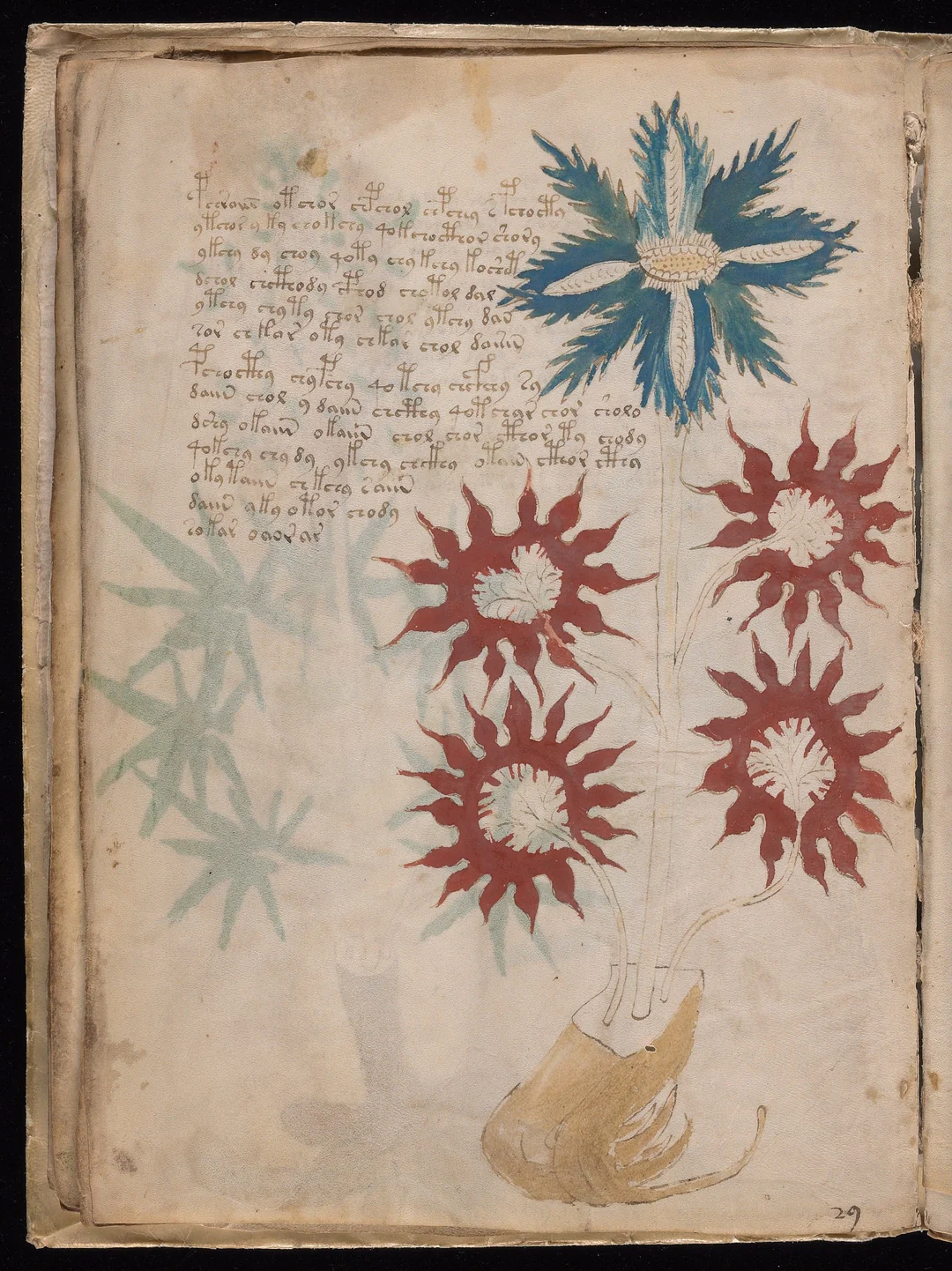
Few historical artifacts generate as much enduring intrigue as the Rohonc Codex. Often compared to the Voynich Manuscript, this small, unassuming book has confounded linguists, historians, and cryptographers for nearly two centuries. Its origins are uncertain, its script remains undeciphered, and its purpose is still hotly debated. What is known, however, is that the Rohonc Codex occupies a unique and perplexing place in the study of mysterious manuscripts.
Discovery and Early History
The Rohonc Codex surfaced in the early 19th century in Hungary. It was donated in 1838 to the Hungarian Academy of Sciences by Gusztáv Batthyány, a Hungarian nobleman. The manuscript takes its name from Rohonc (modern-day Rechnitz, Austria), where it was believed to have been held prior to its donation.
Despite extensive academic attention, no verifiable records exist that document the manuscript’s creation, author, or journey prior to the 19th century. Radiocarbon dating of the paper suggests it was produced in the 16th century, although this does not conclusively indicate when the text itself was written.
Physical Description
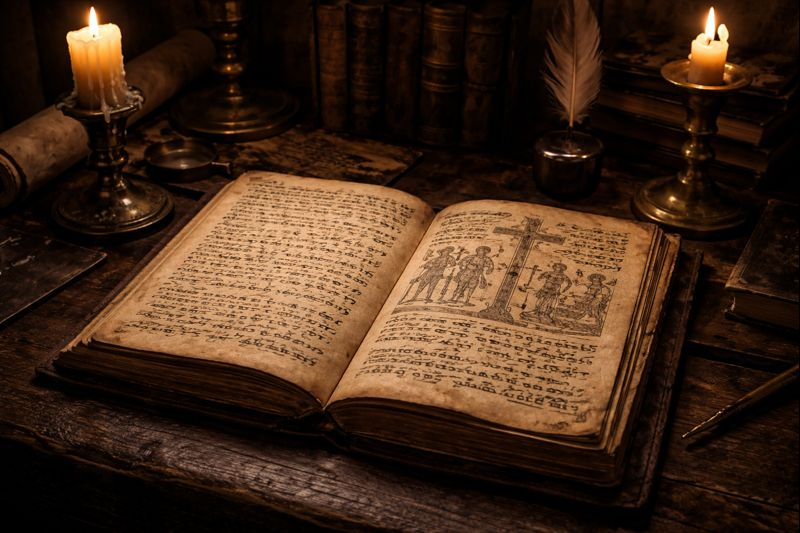
The Rohonc Codex consists of approximately 448 pages, each measuring roughly 12 by 10 centimeters. The manuscript is written entirely in an unknown script composed of hundreds of distinct symbols—far more than would be expected in a typical alphabet. This complexity has made linguistic analysis exceptionally difficult.
Interspersed throughout the text are around 80 small illustrations. These images appear to depict religious scenes, including crucifixions, churches, and ritual gatherings. Notably, the iconography seems to blend Christian elements from both Eastern and Western traditions, further complicating efforts to identify the manuscript’s cultural origin.
The Mysterious Script
One of the most baffling aspects of the Rohonc Codex is its script. Scholars have identified between 200 and 500 unique characters, depending on classification methods. This far exceeds the character count of most known writing systems and has led some researchers to speculate that the text may employ shorthand, ligatures, or even a cipher layered atop a natural language.
Another unusual feature is the apparent right-to-left direction of the writing, inferred from page layout and illustration placement. While this narrows possible linguistic families, it has not led to a definitive breakthrough.
Attempts at Decipherment
Over the years, numerous scholars and amateur cryptographers have attempted to decode the Rohonc Codex. Proposed interpretations have ranged widely, suggesting the text represents:
- A lost or obscure form of Hungarian
- A Turkic or Sumerian-inspired language
- A religious text created by a persecuted sect
- A complex cipher rather than a true language
In the 20th century, researcher Ottó Gyürk claimed partial success by interpreting the manuscript as a religious chronicle written in an archaic form of Romanian using a unique script. However, his conclusions were not widely accepted, as other scholars were unable to replicate his results using consistent methodology.
Hoax or Historical Artifact?
One of the more controversial theories suggests the Rohonc Codex may be an elaborate hoax. Some researchers have pointed to the sheer number of symbols and the lack of statistical patterns typical of natural language as potential indicators of fabrication. A commonly cited suspect is Sámuel Literáti Nemes, a 19th-century antiquarian known for producing forged historical documents.
However, the hoax theory remains unproven. Creating a manuscript of this length and complexity, complete with consistent symbolism and thematic illustrations, would have required extraordinary effort. Moreover, no direct evidence links any known forger to the codex.
Why the Rohonc Codex Still Matters
The Rohonc Codex endures not because of what it explains, but because of what it resists explaining. It challenges assumptions about historical literacy, religious expression, and the limits of modern decipherment techniques. Like the Voynich Manuscript, it serves as a reminder that not all remnants of the past yield easily to contemporary analysis.
For historians, it represents an unresolved data point. For cryptographers, a tantalizing puzzle. And for enthusiasts of the unexplained, it remains a symbol of how much of human history may still be hidden in plain sight.
Conclusion
Nearly two centuries after its introduction to the scholarly world, the Rohonc Codex remains undeciphered and deeply mysterious. Whether it is a genuine relic of a forgotten tradition, an encoded religious text, or an extraordinarily sophisticated hoax, its pages continue to provoke curiosity and debate. Until a verifiable breakthrough occurs, the Rohonc Codex will remain one of history’s most compelling unsolved manuscripts.
Below is a Sources and Further Reading section you can append to the blog article. These are credible academic, museum, and manuscript-history references commonly cited in research on the Rohonc Codex.
Sources and Further Reading
- Hungarian Academy of Sciences (Magyar Tudományos Akadémia)
Custodian of the Rohonc Codex since 1838. Archival descriptions and scholarly notes provide primary reference material on the manuscript’s provenance and early examinations. - Benedek Láng, Unlocked Books: Manuscripts of Learned Magic in the Medieval Libraries of Central Europe
While focused on magical manuscripts, Láng discusses the Rohonc Codex within the broader context of Central European cryptic and esoteric texts, offering valuable historiographical insight. - Ottó Gyürk (20th century research papers)
Proposed one of the most detailed—though controversial—interpretations of the codex, arguing it represents a religious chronicle written in an archaic Romanian dialect. His work is frequently cited in both supportive and critical analyses. - Klaus Schmeh, Codes and Ciphers: A History of Cryptography
Includes discussion of undeciphered manuscripts such as the Rohonc Codex, comparing their statistical irregularities to known cipher systems. - András Róna-Tas, linguistic commentary and critiques
Provided skeptical linguistic evaluations of proposed translations, emphasizing the lack of reproducible decoding methodology. - British Library & European Manuscript Studies (comparative references)
Used by researchers to compare the Rohonc Codex’s structure, iconography, and symbol frequency with other medieval and early modern manuscripts. - Wikipedia: “Rohonc Codex” (for general overview only)
Useful as a starting point for readers, though primary and academic sources are recommended for serious research.
Editorial Note on Sources
Because the Rohonc Codex remains undeciphered, no source can be considered definitive. Scholarly interpretations are often speculative, and responsible study requires cross-referencing multiple perspectives, including critical rebuttals.
https://www.holybooks.com/wp-content/uploads/Rohonc-Codex.pdf