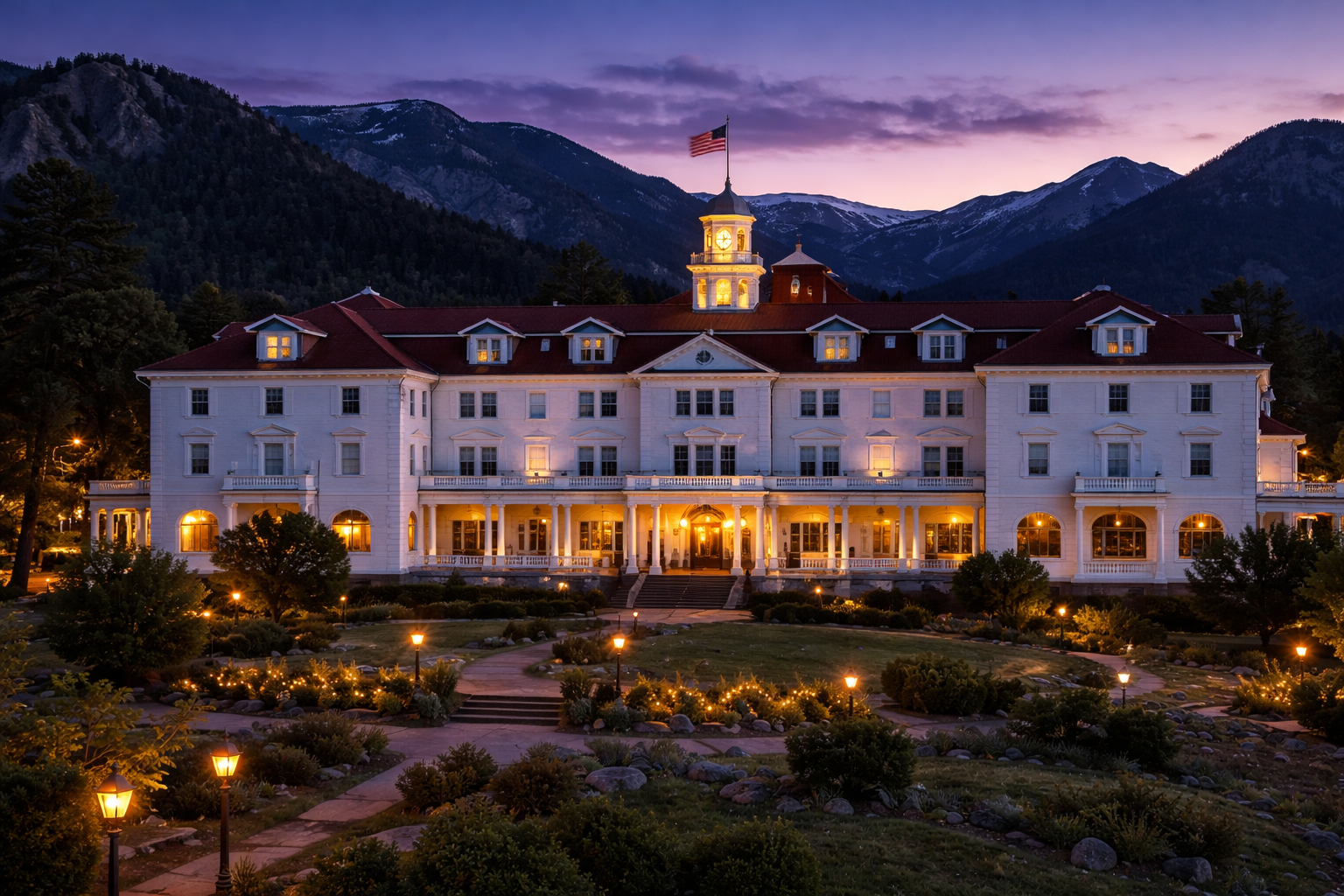
Perched at 7,528 feet above sea level in Estes Park, Colorado, the Stanley Hotel is more than a grand example of early twentieth‑century resort architecture. It is one of the most frequently cited locations in American paranormal history—an establishment where ghost lore, first‑hand testimony, and pop‑culture influence converge. For more than a century, guests and staff have reported unexplained voices, moving objects, phantom music, and full‑body apparitions. Whether approached as folklore, parapsychology, or cultural history, the Stanley remains a cornerstone of modern haunting narratives.
Origins of the Stanley Hotel
The hotel was built in 1909 by Freelan Oscar Stanley, co‑inventor of the Stanley Steamer automobile. Seeking clean mountain air to recover from tuberculosis, Stanley fell in love with the Estes Valley and envisioned a luxury resort that would attract wealthy travelers from the East Coast. The Stanley Hotel opened in 1909 with electric lighting, indoor plumbing, and elegant Georgian Revival styling—features that made it one of the most advanced hotels of its era.
Despite its refined origins, the hotel quickly developed a reputation for unusual activity. Staff journals, guest letters, and later interviews suggest reports of strange occurrences dating back decades, long before the Stanley became associated with horror fiction.
The Stephen King Connection
The Stanley Hotel’s most significant cultural moment came in 1974, when author Stephen King and his wife Tabitha stayed in Room 217. The hotel was preparing to close for the winter, leaving the Kings as nearly the only guests. King later stated that the isolation, combined with unsettling experiences during the night, inspired the setting for The Shining.
While Stanley Kubrick’s 1980 film adaptation was shot elsewhere, King has repeatedly credited the Stanley Hotel as the creative catalyst. This association transformed the hotel from a regional curiosity into a global paranormal destination.
Notable Haunted Locations Within the Hotel
Room 217
Room 217 is the Stanley’s most famous guest room. Reports date back to 1911, when a gas explosion injured head housekeeper Elizabeth Wilson. Though she survived and returned to work, many believe her spirit remains.
Witness Account (Guest, 1990s):
“I left my suitcase open on the bed and went downstairs for dinner. When I returned, my clothes were neatly folded and placed inside the drawers. Housekeeping insisted no one had entered the room.”
Other guests report lights turning on and off, doors opening on their own, and a woman’s voice asking questions late at night.
Room 401
Room 401 is often associated with the apparition of a tall man in formal attire, believed to be Lord Dunraven, an early landowner in the Estes Valley.
Witness Account (Maintenance Worker):
“I was checking the locks when I saw a man in a black coat standing near the window. When I spoke to him, he turned and vanished. There was nowhere he could have gone.”
Guests in Room 401 frequently report feelings of being watched, sudden cold spots, and shadow figures.
The Concert Hall
The Stanley’s concert hall is linked to Freelan Oscar Stanley himself, a passionate music lover.
Witness Account (Piano Technician):
“I heard a piano playing softly while I was locking up. When I entered the hall, the room was empty, and the piano lid was closed.”
Phantom piano music is one of the most consistent reports, often described as gentle and melodic rather than threatening.
The Fourth Floor
Once the children’s area of the hotel, the fourth floor is now considered one of the most active zones.
Witness Account (Tour Participant):
“We heard laughing and running footsteps above us, but when we checked, the hallway was empty. The laughter sounded playful—like children at a game.”
Guests also report toys moving, lights flickering, and doors slamming without explanation.
Staff Experiences
Employees of the Stanley Hotel often accumulate experiences over years of work, lending a cumulative weight to the reports.
Witness Account (Former Night Auditor):
“I would hear phones ring in empty rooms and see elevator lights activate on their own. After a while, you stop reacting—it’s just part of the night shift.”
Several staff members claim they have seen full‑body apparitions in period clothing, particularly in service corridors and stairwells.
Paranormal Investigations
The Stanley Hotel has been investigated by numerous paranormal research teams and television programs. Investigators report electronic voice phenomena (EVPs), unexplained temperature fluctuations, and anomalous EMF readings, particularly in Room 217, the concert hall, and the fourth floor.
While skeptics attribute these findings to environmental factors such as old wiring, altitude effects, and human psychology, proponents argue that the consistency of experiences across decades suggests something more.
Skeptical Perspectives
From a critical standpoint, the Stanley Hotel presents ideal conditions for heightened suggestibility: isolation, dramatic architecture, and a powerful narrative reinforced by tours and media coverage. Environmental explanations include:
- Rapid temperature changes due to mountain weather
- Acoustic anomalies in large hallways
- Aging infrastructure causing electrical irregularities
Even so, many witnesses insist their experiences occurred without prior knowledge of the hotel’s legends.
Cultural Legacy
The Stanley Hotel has become a pilgrimage site for paranormal enthusiasts, horror fans, and historians alike. Its influence extends beyond ghost tourism, shaping modern haunted‑hotel mythology and inspiring countless books, documentaries, and investigations.
Whether viewed as genuinely haunted or as a masterclass in atmospheric storytelling, the Stanley Hotel occupies a unique place in American folklore—where personal testimony, history, and imagination intersect.
Conclusion
The enduring reputation of the Stanley Hotel rests not on a single event, but on the accumulation of witness accounts spanning more than a century. From neatly folded clothes to phantom music and vanishing figures, the stories remain remarkably consistent across time and demographics.
For believers, the Stanley is a living archive of restless spirits. For skeptics, it is a fascinating case study in environment, expectation, and narrative power. Either way, the Stanley Hotel continues to watch over Estes Park, its lights glowing warmly against the mountain night—inviting guests to decide for themselves what lingers after checkout.

The Stanley Hotel: Rooms Most Frequently Reported as Active
For more than a century, guests and staff at the Stanley Hotel have reported recurring paranormal phenomena in specific locations. While accounts vary in intensity and interpretation, certain rooms and areas appear consistently across witness testimony, staff recollections, and investigation reports. The following overview consolidates the spaces most frequently cited as “active,” based on repeated descriptions rather than isolated anecdotes.
Room 217 – The Epicenter of Stanley Lore
Reported Phenomena:
- Objects moved or arranged without explanation
- Lights activating independently
- Disembodied voices and whispering
- Feelings of being watched or addressed directly
Room 217’s reputation dates to 1911, when head housekeeper Elizabeth Wilson was injured in a gas explosion. Although she survived and continued working at the hotel, many guests believe her presence lingers.
Representative Guest Account:
“It felt as though someone was in the room with us, not threatening—just present. The bathroom light turned on twice during the night.”
Room 217 remains one of the most requested rooms by paranormal tourists and is often described as active even by guests unfamiliar with its history.
Room 401 – The Lord Dunraven Apparition
Reported Phenomena:
- Apparition of a tall man in period clothing
- Cold spots and pressure changes
- Shadow figures near windows and hallways
The entity associated with Room 401 is commonly identified as Lord Dunraven, an Irish nobleman who once claimed large tracts of land in the Estes Valley.
Staff Account:
“I saw a man standing by the window as clear as day. When I blinked, he was gone. There was no sound, no door opening—nothing.”
Room 428 – Physical Interaction Reports
Reported Phenomena:
- Sensations of being touched or shaken
- Furniture movement
- Sudden temperature drops
Room 428 is less famous than 217 but has generated some of the most unsettling physical interaction claims.
Guest Account:
“I felt someone tug the covers off the bed. I sat straight up, convinced another person was in the room.”
The Fourth Floor – Children’s Activity
Reported Phenomena:
- Sounds of running and laughter
- Doors opening and closing
- Apparent childlike voices
Originally designed as a children’s area, the fourth floor is frequently cited as one of the hotel’s most active zones.
Tour Witness Account:
“We heard footsteps racing past us, but the hallway was empty. The sound echoed like kids playing a game.”
Many experiences on this floor are described as playful rather than threatening.
The Concert Hall – Phantom Music
Reported Phenomena:
- Piano music without a visible source
- Apparitions near the stage
- Lights activating after hours
Freelan Oscar Stanley was an avid music lover, and many believe his presence is tied to the concert hall.
Technician Account:
“The piano was playing softly when I entered. No one was there, and the bench hadn’t been moved.”
Stanley Hotel Sightings Timeline
The following timeline highlights key moments and eras frequently referenced in Stanley Hotel paranormal history. Dates are approximate and reflect the earliest or most notable reporting periods.
1909–1911: Opening Years
- Hotel opens to guests in 1909
- 1911 gas explosion injures Elizabeth Wilson in Room 217
- Early staff journals reference unexplained noises and lights
1920s–1930s: Staff Reports Increase
- Employees report hearing music after hours
- Sightings of a formally dressed man in hallways begin appearing in oral accounts
1950s–1960s: Quiet Reputation
- Paranormal stories circulate locally but remain largely undocumented
- Guests occasionally mention odd experiences in letters and travel notes
1974: Stephen King Stay
- Stephen and Tabitha King stay in Room 217
- Experience cited as inspiration for The Shining
- Stanley Hotel gains national attention
1980s–1990s: Public Interest Grows
- Ghost tours begin
- Media outlets publish guest experiences
- Room 217, 401, and the concert hall become focal points
2000s: Paranormal Investigations
- Multiple investigative teams conduct overnight studies
- EVP recordings and EMF anomalies reported
- Television programs feature the hotel
2010s–Present: Cultural Landmark
- Stanley recognized as both a historic and paranormal destination
- Consistent reports from guests unfamiliar with the hotel’s legends
- Paranormal tourism becomes a core aspect of the Stanley’s identity
Closing Analysis
The Stanley Hotel’s reputation is not built on a single dramatic incident, but on repetition. The same rooms, sounds, and apparitions appear across decades of testimony from individuals with no connection to one another. Whether interpreted as residual hauntings, intelligent entities, or the result of environment and expectation, the consistency itself is noteworthy.
For researchers, the Stanley provides a rare opportunity: a controlled, well-documented location where history, architecture, and narrative intersect. For guests, it remains a place where the ordinary and the unexplained seem unusually close.