The World’s Most Mysterious Book That Refuses to Be Read
In 1912, a rare book dealer opened a locked chest in a Jesuit college near Rome and unknowingly reignited one of the greatest unsolved puzzles in human history. Inside was a strange manuscript—hundreds of pages filled with indecipherable writing, bizarre illustrations of unknown plants, naked women bathing in green liquid, and elaborate diagrams that seemed to blend astronomy, biology, and alchemy.
More than a century later, the Voynich Manuscript remains unread.
No one knows who wrote it.
No one knows what language it uses—if it’s a language at all.
And no one can agree on whether it is a lost scientific work, an encoded medical text, a mystical tome… or the most elaborate hoax ever created.
A Book That Should Not Exist
The Voynich Manuscript is a vellum codex of approximately 240 surviving pages, though evidence suggests it was once longer. Carbon dating places the parchment firmly in the early 15th century, between 1404 and 1438—a result that has been verified repeatedly.
The text itself, however, does not resemble any known language.
It is written left to right, with consistent spacing and repeated word patterns that resemble grammar. The script flows smoothly, as if written by a confident, practiced hand—not someone inventing symbols on the fly. Statistical analysis shows the text follows rules similar to natural languages, yet it does not match Latin, Hebrew, Arabic, or any known medieval tongue.
This contradiction—structure without meaning—is at the heart of the mystery.
Wilfrid Voynich and the Manuscript’s Rediscovery
The manuscript is named after Wilfrid Voynich, a Polish book dealer and revolutionary-turned-antiquarian who purchased it in 1912. Voynich believed he had discovered something extraordinary and devoted years to uncovering its origins.
A letter found with the manuscript suggested it once belonged to Emperor Rudolf II of Bohemia, a ruler obsessed with alchemy, astrology, and the occult. According to the letter, Rudolf may have paid the equivalent of millions of dollars for the book, believing it to be the work of Roger Bacon, a 13th-century English philosopher rumored to possess forbidden knowledge.
If true, the manuscript was already legendary centuries before modern scholars ever saw it.
The Strange Illustrations
The Voynich Manuscript is traditionally divided into sections based on its illustrations, each more unsettling than the last.
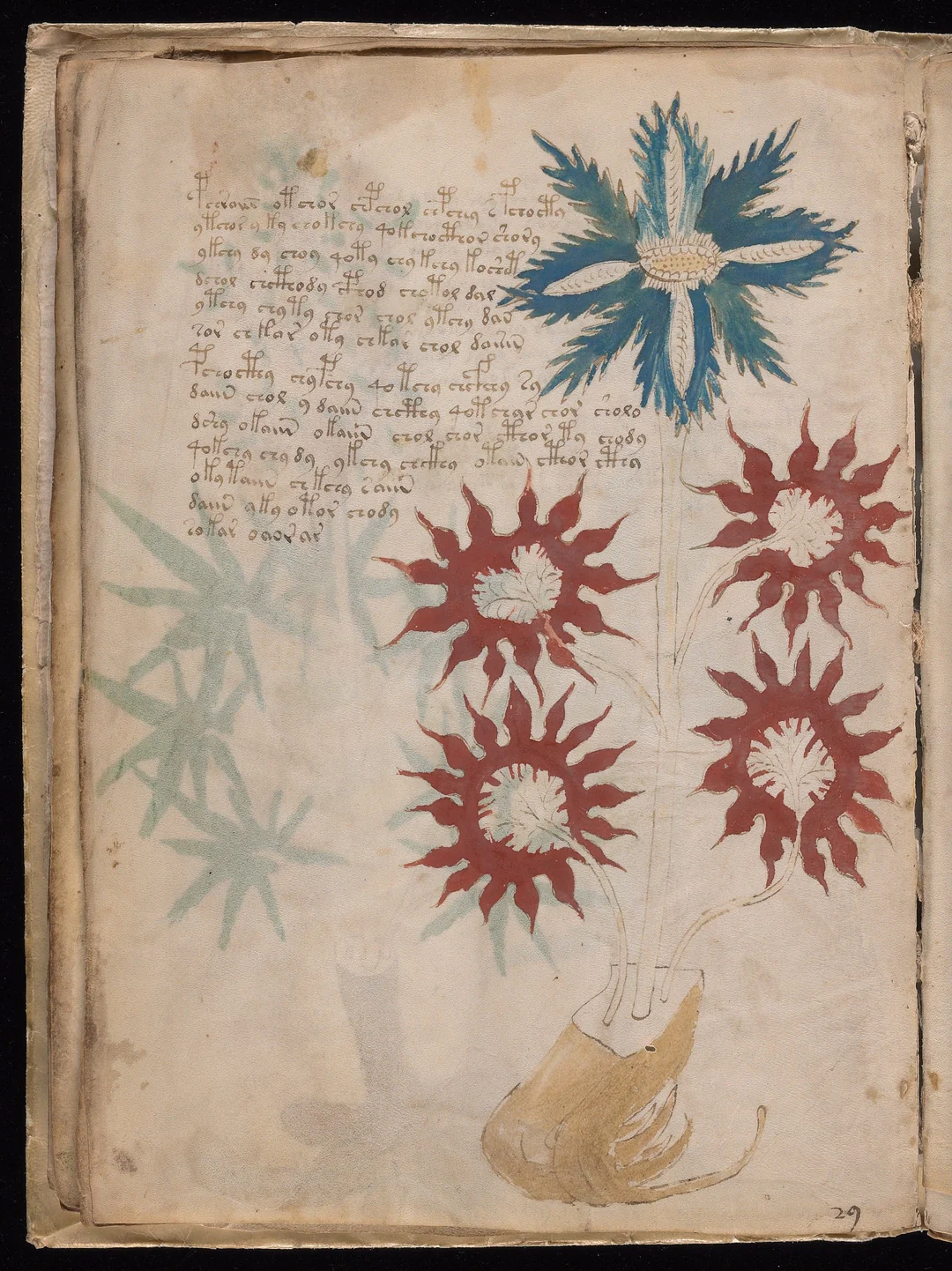
1. Botanical Section
The largest portion depicts plants—yet none of them correspond to any known species. Roots twist unnaturally, leaves combine features from different families, and flowers appear almost alien.
Some researchers believe these are symbolic or composite plants used in alchemy or medicine. Others argue they represent flora from an unknown region—or an entirely fictional bestiary of healing plants.
2. Astronomical and Astrological Diagrams
Circular diagrams show suns, moons, stars, and zodiac symbols. While some zodiac signs resemble medieval European styles, others contain unfamiliar elements, suggesting a hybrid system or a distorted copy of known astronomy.
3. The “Biological” Section
Perhaps the most disturbing images depict nude women bathing in interconnected pools, tubes, and vessels filled with green liquid. Some appear to flow through pipe-like systems resembling organs or alchemical apparatus.
Interpretations range from female anatomy and fertility rituals to alchemical purification processes—or symbolic representations of the soul moving through the body.
4. Pharmaceutical and Recipe Sections
Pages show jars, roots, and short blocks of text—suggesting medicinal recipes or instructions. If this is a medical manual, its knowledge has been completely lost.
Attempts to Decode the Text
For over 100 years, the Voynich Manuscript has defeated some of the greatest minds in history.
- World War II codebreakers, including experts who cracked Nazi ciphers, failed to decode it.
- Linguists, cryptographers, AI researchers, and amateur sleuths have proposed hundreds of solutions.
- Modern computer analysis confirms the text is not random gibberish—yet no translation has been universally accepted.
Proposed explanations include:
- An unknown natural language
- A complex cipher system
- A phonetic shorthand
- An artificial or constructed language
- A meaningless hoax designed to look real
Each theory solves part of the puzzle—and fails at another.
Hoax or Hidden Knowledge?
The hoax theory is tempting. After all, medieval con artists existed, and alchemical scams were common. But several problems undermine this explanation:
- Creating such a long, internally consistent fake language would require extraordinary effort.
- The manuscript follows linguistic laws discovered centuries later.
- The parchment and ink are authentic to the medieval period.
- There is no obvious payoff—no hidden message revealing the trick.
If it is a hoax, it may be the most sophisticated and pointless hoax ever made.
Alternatively, the manuscript may represent knowledge deliberately encoded—medical, spiritual, or scientific information meant only for an initiated few.
Or perhaps it was written in a real language that simply didn’t survive.
Why the Voynich Manuscript Still Matters
The Voynich Manuscript endures because it resists closure.
In a world where satellites map every corner of the planet and AI translates ancient languages in seconds, this book remains silent. It is a reminder that human history still holds secrets—not buried underground, but sitting in plain sight.
Today, the manuscript is housed at Yale University’s Beinecke Rare Book Library, fully digitized and available to the public. Anyone can study it. Anyone can try to crack it.
And yet, it remains unread.
A Book Waiting for the Right Mind
The Voynich Manuscript does not scream its secrets. It waits.
Perhaps the answer lies in a lost context, a forgotten discipline, or a mind willing to see it differently. Or perhaps it was never meant to be understood at all.
Until then, the Voynich Manuscript stands as one of the most haunting artifacts ever created—a book written in a language no one remembers, filled with knowledge no one can access, from a past that refuses to explain itself.
And somewhere within those looping characters and impossible plants, the truth may still be hiding—unchanged for over six hundred years.
Modern AI and the Promise of a Breakthrough
In recent years, the Voynich Manuscript has entered a new phase of investigation—one driven not by lone cryptographers or academic committees, but by artificial intelligence. Machine learning, pattern recognition, and large-scale linguistic modeling have all been deployed in hopes of finally extracting meaning from the manuscript’s stubborn script.
These efforts have produced headlines, bold claims, and renewed public interest—but no consensus.
Early Statistical AI Models
Some of the first AI-driven analyses focused on statistical structure rather than translation. These systems confirmed what earlier researchers suspected: the Voynich text behaves like a real language. Word frequencies follow Zipf’s Law, repetition patterns suggest grammar, and sentence-like structures recur throughout the manuscript.
What AI could not determine was meaning. The models could say how the text behaves—but not what it says.
The Hebrew and Semitic Language Claims
Several AI-based studies claimed the manuscript was encoded Hebrew or another Semitic language, arguing that rearranging letters or applying simple substitution revealed readable text. These claims gained media traction, but linguists quickly pushed back.
Problems included:
- Selective decoding that worked only on short samples
- Heavy reliance on assumed letter mappings
- Translations that required extensive interpretation to make sense
Most scholars concluded these were examples of pattern overfitting—AI finding structure because it was instructed to look for it.
Neural Networks and “Proto-Language” Theories
More recent models have suggested the Voynich Manuscript may represent a constructed or proto-language, possibly designed for secrecy or ritual use. AI systems comparing it to thousands of known languages found partial similarities—but no clear matches.
These results raised a disturbing possibility: the manuscript may not be encoded at all. It may be written in a system that never existed outside this book.
Why AI Still Fails
Despite massive computing power, AI faces the same core obstacle as human researchers: no reference point. There is no known key, no bilingual text, no external document to anchor meaning. AI excels when patterns can be cross-referenced. The Voynich Manuscript exists in isolation.
Without context, even the most advanced systems can only speculate.
The Uncomfortable Conclusion
AI has not solved the Voynich Manuscript—but it has reinforced one crucial truth: this is not random nonsense. Whatever the manuscript is, it was produced deliberately, intelligently, and with internal consistency.
Whether it encodes lost knowledge, represents a private symbolic system, or was designed to conceal meaning forever, remains unanswered.
For now, artificial intelligence has joined the long list of brilliant minds forced to admit defeat.
And the manuscript remains silent.
https://www.holybooks.com/wp-content/uploads/Voynich-Manuscript.pdf