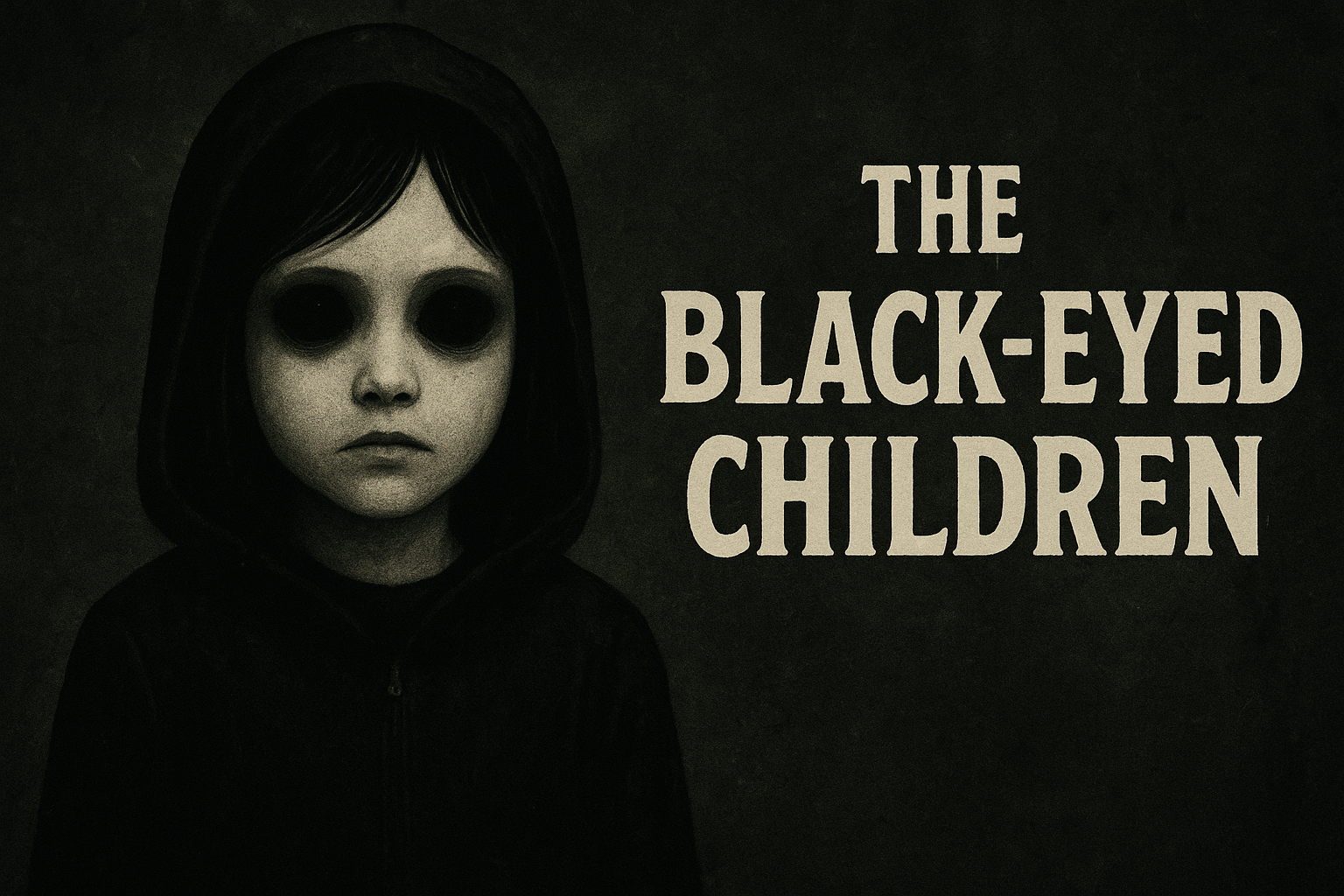
The Black-Eyed Children: Origins, Lore, and Modern Interpretations
The legend of the Black-Eyed Children—mysterious youths with pale skin, monotone voices, and fully black eyes—has become one of the most enduring and unsettling modern paranormal stories. Blending urban legend, creepypasta, and eyewitness “encounter” narratives, the phenomenon occupies a unique place in contemporary folklore. Though there is no evidence supporting their literal existence, the stories surrounding them reveal a great deal about fear, imagination, and the evolution of digital-age mythology.
What Are the Black-Eyed Children?
Black-Eyed Children (or B.E.K.s) are described as children or teens aged roughly 6–16 with:
- Completely black eyes—no whites, no iris
- Pale or sickly-looking skin
- Outdated or ill-fitting clothing
- A strange, emotionless demeanor
- A sense of dread reported by witnesses
These children typically appear at night, approaching people at homes, cars, or businesses. In nearly every story, they make a calm, repeated request—such as asking to enter a house, borrow a phone, or get a ride—and become increasingly insistent when denied.
Many accounts emphasize that witnesses feel an overwhelming fear or the sense that “something is wrong” even before noticing the eyes.
Origins of the Legend
Unlike many older supernatural myths, the Black-Eyed Children phenomenon has a clear documented starting point.
The 1996 Brian Bethel Story
Most researchers trace the modern legend to a post written by journalist Brian Bethel in 1996. Bethel described being approached by two boys outside a movie theater in Abilene, Texas. The boys asked for a ride home to retrieve money for a movie, but Bethel suddenly felt terrified—an irrational but overwhelming panic. He then noticed their pitch-black eyes.
Bethel’s story spread through early internet forums and email chains, becoming one of the first iconic internet-era ghost stories.
Growth Through the Internet
The legend gained momentum through:
- Creepypasta sites
- Reddit and paranormal forums
- YouTube storytelling channels
- Local ghost hunting groups
By the mid-2000s, Black-Eyed Children had become a global phenomenon, with “encounters” reported in the U.K., Canada, Australia, and beyond.
Common Themes in Encounter Stories
Despite being spread widely by unrelated individuals, Black-Eyed Children accounts share striking similarities:
1. Requests for Permission
The children always ask to be invited in—echoing folklore about vampires and malevolent spirits. They may say:
- “Let us in.”
- “We need to call our mother.”
- “We can’t come in unless you say it’s okay.”
2. Emotional Manipulation
They often speak calmly, slowly, or monotonously, with unnatural phrasing:
- “It will only take a moment.”
- “We don’t have much time.”
Their speech appears rehearsed or “off,” adding to the eeriness.
3. Sudden Dread
Witnesses often report:
- A drop in temperature
- A sense of paralysis
- Feeling watched
- An overwhelming instinct to flee
This detail parallels sleep paralysis accounts, UFO lore, and demonology—suggesting psychological roots.
4. Abrupt Disappearance
In many stories, the children vanish the moment a witness refuses their request, often leaving no footprints or signs they were ever present.
Explanations and Interpretations
1. Urban Legend and Creepypasta
The simplest explanation is that the Black-Eyed Children are a modern urban legend, shaped by the digital age. Bethel’s original story, whether fictional or misinterpreted, provided a template that others expanded upon.
2. Misidentified Medical Conditions
Certain eye disorders (like mydriasis or aniridia) can cause extremely dark pupils. Dim lighting, stress, and adrenaline can amplify misperception, especially if someone is already nervous.
3. Psychological Factors
Fear can distort perception. Scientists note that when people feel threatened in low-light environments:
- Shadows seem deeper
- Eyes appear darker
- Details become exaggerated
This may explain the recurring “black-eyed” detail.
4. Folkloric Archetypes
The Black-Eyed Children echo several older mythologies:
- Vampires needing permission
- Fairy changelings mimicking children
- Demons disguised as innocents
- Men in Black (MIB) with unnatural features
These parallels suggest the legend taps into deep-rooted fears about the unknown.
5. Social and Digital Influence
Stories spread rapidly online, inspiring new accounts that match the established format. This creates a feedback loop, reinforcing the legend’s consistency and credibility among believers.
Cultural Impact
The Black-Eyed Children have influenced:
- Horror films and short stories
- Paranormal documentaries
- Podcasts and YouTube channels
- Comic books and art
- Halloween costumes
Their blend of innocence and horror makes them especially unsettling—and therefore compelling to storytellers.
Why the Legend Endures
Urban legends survive when they reflect collective anxieties. The Black-Eyed Children represent:
- Fear of the unknown
- Distrust of strangers
- Protective instincts around children
- Modern isolation and nighttime safety concerns
They are a folk horror for the digital era, evolving with new platforms and audiences.
Final Thoughts
The Black-Eyed Children legend is a fascinating example of how modern folklore forms, spreads, and mutates. Whether viewed as a psychological phenomenon, creative storytelling, or a paranormal mystery, the stories continue to captivate audiences worldwide.