A Deep Dive into a Unusual Military-Grade UFO Sighting
📍 What is the “Jellyfish” UAP?
The “Jellyfish” is a term given to an alleged unidentified anomalous phenomenon (UAP) recorded by U.S. military sensors over Iraq in 2018 (or 2017, per some accounts). (A Singular Fortean)
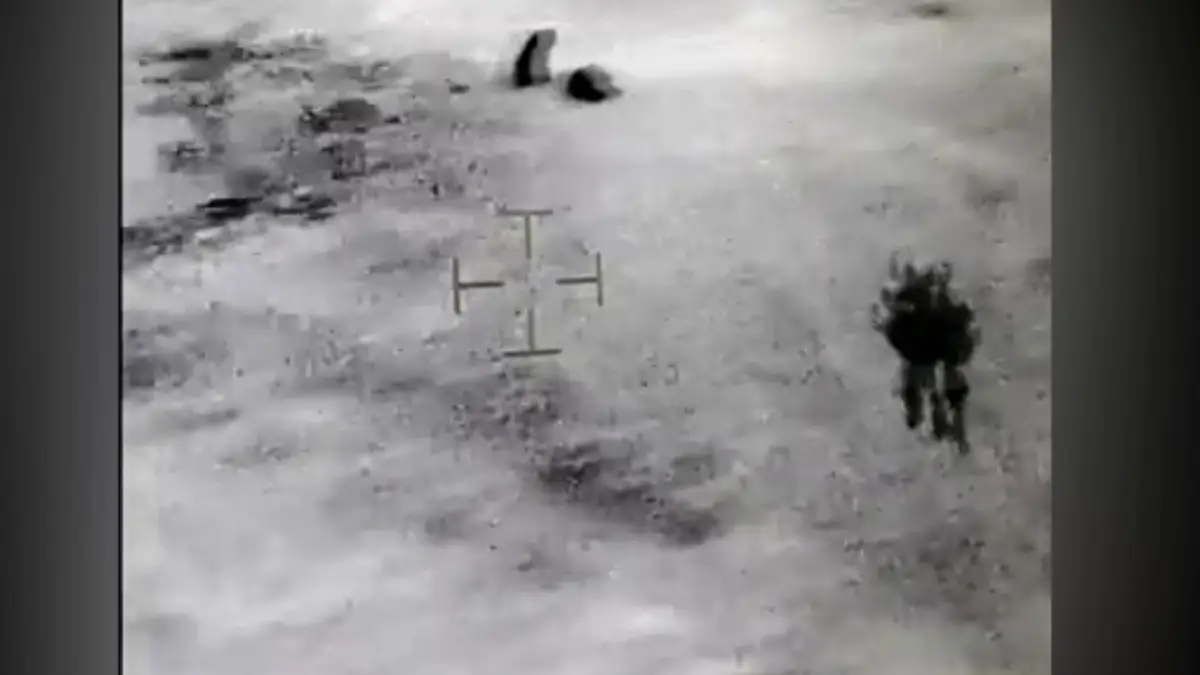
It was uploaded publicly in early 2024 by investigative filmmaker Jeremy Corbell, who described the object as a UAP of unknown origin and said it was officially designated by U.S. intelligence as such. (A Singular Fortean)
Eyewitnesses and some former military personnel — most notably a veteran surveillance-controller named Michael Cincoski — have spoken about multiple sightings. According to Cincoski, the UAP “haunted” the base and became an oft-told “ghost story” among troops. (Arab News)
🎥 What Does the Footage Show?
According to the released video and related descriptions:
- The object appears over a U.S. operations base under infrared (thermal) surveillance, not visible on standard night vision. (The Daily Jagran)
- The shape is described as resembling a jellyfish or a chandelier — a central body with several dangling appendages or “tentacles/legs.” (Arab News)
- After hovering over the base, the object allegedly flew toward a nearby body of water, submerged for roughly 17 minutes, and then re-emerged — reportedly accelerating sharply upward at an extreme speed. (The Western Journal)
- Additional claimed characteristics: “trans-medium” capability (air → water → air), “positive lift” without visible aerodynamic control surfaces, and interference with targeting optics on the base’s surveillance platform. (A Singular Fortean)
If those claims are accurate, then the “Jellyfish” would challenge many conventional assumptions about aerial vehicles or natural phenomena.
🧑✈️ What Do Military Witnesses Say?
Cincoski — the Marine Corps veteran — said he saw the footage in 2018 after being deployed to the base. He clarified that although the object was tracked, no defensive action was taken. The UAP was never determined to be a threat. (Arab News)
Cincoski also disputed parts of the “official” narrative: he said they never saw the object dive underwater or shoot back into the sky as claimed in the public description. Instead, the object simply drifted away until it was no longer visible. (Arab News)
He offered a more mundane explanation: possibly a glitch or artifact in the surveillance balloon’s camera system, or some misinterpreted object. (A Singular Fortean)
🔍 Skeptical Analyses & Alternative Explanations
A key critical analysis comes from the photo-analysis team affiliated with MUFON, which concluded that:
- The shared video appears to be screen-grabs from a broadcast, not raw sensor data — meaning important metadata (like timing, camera settings, full-resolution frames) is missing. (coloradomufon.org)
- Because of that lack of provenance, the video cannot be reliably validated. (coloradomufon.org)
- Reported claims of “trans-medium capability,” submersion, and re-emergence rely on second-hand descriptions rather than verifiable visual evidence (the portion showing the alleged dive and rapid ascent hasn’t been released). (coloradomufon.org)
Other skeptics suggest a far simpler explanation: a tethered surveillance balloon (or clusters of balloons) drifting in the air — whose shape and motion, under distorted infrared imaging, might create illusions of a “jellyfish” with legs. This explanation was favored by some base personnel and analysts. (A Singular Fortean)

⚠️ What Remains Unknown & Unconfirmed
- The full, unedited raw sensor footage has never been made public.
- There is no public official confirmation from the U.S. Department of Defense about the object’s origin, purpose, or ultimate classification beyond “UAP.” (A Singular Fortean)
- Key claims — submersion, re-emergence, rapid acceleration — are based on descriptions, not clear visual evidence.
- The ambiguous nature of the recorded data (no metadata, questionable video provenance) leaves open the possibility of misinterpretation, optical artifacts, or mundane explanations.
🧠 Why the “Jellyfish” Case Matters
- It stands out as a rare UAP report involving potential “trans-medium” behavior — an object allegedly capable of traversing air and water. If verified, that defies conventional aerospace and marine engineering paradigms.
- It comes from military-grade sensors at a sensitive facility — not from civilians or amateur footage. That raises the stakes for credibility.
- It exemplifies — good or bad — the difficulty of verifying UAP evidence: even potentially high-quality footage can be rendered ambiguous by lack of context, missing metadata, or restricted release.
Here’s a timeline of the key reported events, releases, and open questions related to the so-called “Jellyfish UAP” over Iraq. Because publicly available info is patchy, some dates are approximate and some entries reflect claims rather than confirmed facts.
📅 Timeline of the Jellyfish UAP Reports & Releases
| Date / Year (approx) | Event / Report | Notes & Uncertainty |
|---|---|---|
| 2018 (or 2017 — according to some accounts) | The UAP was allegedly observed by U.S. military sensors over a U.S. operations base in Iraq. The object reportedly hovered over the base, then — according to some descriptions — descended toward nearby water, submerged for some time, then re-emerged and accelerated upward. | The exact date, time, and base location have not been publicly verified. The account is largely based on testimony by a former servicemember. |
| Shortly after sighting (allegedly 2018) | The incident reportedly became a well-known “ghost story” among personnel stationed at the base. Some watchers logged the object on infrared (thermal) sensors. | No public logs, raw sensor data, or unedited footage from that time have ever been released. |
| January 2024 (early 2024) | A video claiming to show the “Jellyfish UAP” was publicly uploaded by investigative filmmaker Jeremy Corbell. | The footage was broadcast/released as a compressed or processed copy; critics note that metadata and raw sensor-level data (time stamps, original resolution, uncompressed thermal data) were not made available. |
| Shortly after public release (2024) | Testimony surfaced from a former Marine Corps surveillance-controller — Michael Cincoski — who claimed to have seen the footage years prior. He stated that the object was “tracked,” but denied that personnel ever saw it dive underwater or shoot back into the sky as described in some public narratives. | This statement calls into question some of the more sensational claims (submersion, rapid ascent). |
| Post-release 2024 | Independent analysis by at least one photo/footage-analysis group affiliated with MUFON concluded that the publicly shared video appears to be screen-grabs from a broadcast, not raw sensor data. | Because of that, the analysis group argued that the video lacks the provenance needed for reliable validation (no timestamp metadata, no camera/ sensor parameters, no original resolution) — meaning the “trans-medium” claims, submersion, and re-emergence cannot be independently verified. |
| Present | The case remains open and controversial. No public, unedited raw sensor footage has been released. No official government confirmation or explanation has been made public. The object remains classified (to the public) simply as a “UAP.” | The lack of verified data, and conflicting accounts even among purported eyewitnesses, means that the “Jellyfish” remains speculative. |
⚠️ Key Points — What We Know, What Is Disputed / Unknown
- ✅ We know there is a publicly released video purporting to show the “Jellyfish” UAP — thanks largely to Jeremy Corbell’s 2024 upload.
- ✅ We know that at least one former servicemember claims to have seen it years earlier, and that the event (or versions of it) circulated among base personnel.
- ❓ We do not know: the exact original date/time of the encounter; the precise location (which base); the raw, unedited thermal-sensor footage; or independent verification of the most dramatic claims (submersion, underwater travel, re-emergence, rapid ascent).
- ❓ We do not know whether the object represents a craft, a natural phenomenon, an artifact or glitch (e.g. imaging/ sensor error), or some other misidentified source.
- ⚠️ We do know that the publicly available video has serious limitations: lacking metadata and original sensor data, making it scientifically weak as definitive evidence.
🧮 Why This Timeline Matters
- It shows how the story relies heavily on a mix of oral testimony, edited footage, and journalistic/filmmaker presentation — rather than on consistently verified data.
- It underlines a core challenge with many UAP cases: without raw sensor data, independent verification is extremely difficult.
- It reveals how accounts even from supposed eyewitnesses can vary — some remember dramatic behavior; others recall only a drifting object.
- It highlights how once a narrative becomes public, it tends to evolve (or be embellished), making it harder to distinguish fact from anecdote.